Navigating the Three-Person Playdate: Children’s Books for the “Third Wheel”
You know the exact scene.
First, two kids play in perfect harmony.
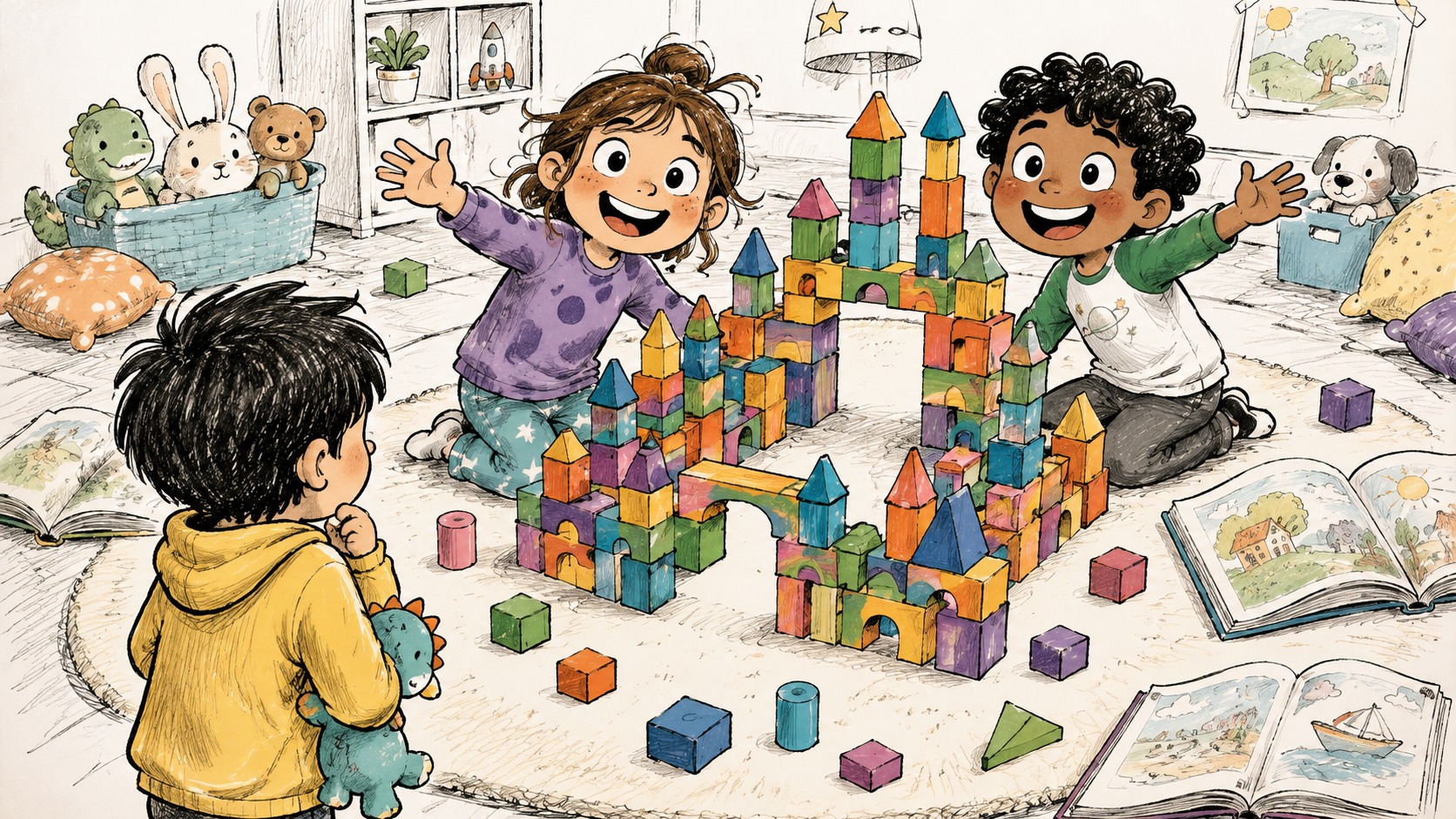
They build a giant block tower.
Next, a third child enters the room.
Suddenly, the block tower falls down.
Soon, one child sits on the sidelines.
They feel totally left out.
Welcome to the dreaded three-person playdate.
Indeed, there is an awkwardness to this tiny group.
It often leaves one child feeling very sad.
As adults, we know how to easily widen a circle.
However, children are still building these social skills.
When a new friend arrives, the original duo feels threatened.
Therefore, they fiercely guard their shared play.
Meanwhile, the new arrival feels the deep sting of exclusion.
As a parent, you probably want to step in.
But true inclusive play is an internal choice.
It is about helping your child develop real empathy.
Also, it teaches them that friendship is not limited.
Instead, friendship grows bigger when we invite others inside.
Thankfully, children’s books offer a great mirror for these moments.
Therefore, here are eight amazing books about the virtue of inclusive play.
Big Friends by Linda Sarah and Benji Davies
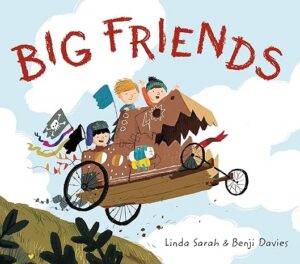
This is a wonderful book about the three-person playdate.
First, it captures the protective nature of a best friendship.
Also, it shows the real grief a child feels when a newcomer arrives.
What kids notice: Children easily connect with the cardboard boxes.
Story snapshot: Birt and Etho are best friends who create magical box worlds.
Then, a boy named Shu arrives.
Etho is thrilled, but Birt feels entirely pushed out.
Eventually, Etho and Shu build a massive, wheeled machine.
They specifically design it to bring Birt back into the game.
Why this book helps: This book provides immense value by validating the third wheel.
It acknowledges that expanding a friendship circle is hard.
Finally, it teaches kids that making room for a third person makes friendship stronger.
Chester’s Way by Kevin Henkes
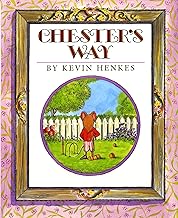
Kevin Henkes taps directly into the minds of young children.
In this classic story, he explores the comfort of daily routine.
It looks at what happens when a duo meets someone totally different.
What kids notice: Kids love the rigid routines of Chester and Wilson.
Story snapshot: Chester and Wilson are best friends who do everything exactly the same way.
Then, a wild girl named Lilly moves into the neighborhood.
The boys want absolutely nothing to do with her.
However, Lilly soon saves them from older bullies.
From that moment on, the rigid duo becomes a happy trio.
Why this book helps: This story perfectly addresses the fear of the unknown.
Children often reject a third playmate because that person plays differently.
By showing Lilly’s wild habits, the book teaches kids that different is fun.
Consequently, it shows how a circle of two becomes a vibrant circle of three.
Can I Play Too? by Mo Willems
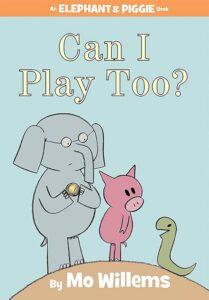
Elephant and Piggie perfectly capture childhood social dynamics.
This funny book tackles inclusion with a very silly premise.
Overall, it is a fast-paced and high-energy read.
What kids notice: Children are instantly drawn to the physical comedy.
Story snapshot: Gerald and Piggie are getting ready to play catch.
Next, a friendly snake slithers up and asks to join.
Gerald and Piggie are eager to include him.
However, they quickly realize Snake has no arms.
Instead of leaving Snake out, the trio brainstorms a hilarious solution.
Why this book helps: This book serves as a brilliant introduction to adaptive play.
It helps children understand that you do not abandon a new friend.
Instead, you simply change the game.
Therefore, it teaches young readers that creative thinking helps everyone play.
Strictly No Elephants by Lisa Mantchev
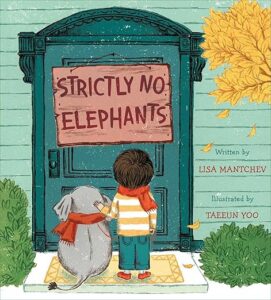
This book uses unusual pets to discuss exclusion.
It is a gentle book with a quiet main character.
Overall, it is a beautiful story about finding your true people.
What kids notice: Young readers instantly love the tiny pet elephant.
Story snapshot: A young boy and his tiny pet elephant do everything together.
Sadly, they are banned from the local treehouse club.
Dejected and sad, the boy walks away.
Soon, he spots a girl sitting alone with her pet skunk.
Together, they form their own club and invite everyone to join.
Why this book helps: This story teaches the active nature of inclusive play.
Knowing how exclusion feels is a powerful motivation to help others.
The boy channels his pain into creating a radically welcoming space.
Finally, it empowers kids to open the door wide for others.
The Invisible Boy by Trudy Ludwig
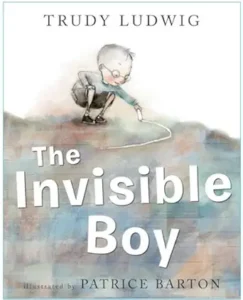
This is a deeply moving masterpiece about quiet children.
It addresses the passive exclusion of simply being overlooked.
Indeed, it is a critical read for highly social children.
What kids notice: Children are fascinated by the visual change in Brian.
Story snapshot: Brian is the invisible boy.
Nobody ever includes him in their games.
When a new student named Justin arrives, the other kids laugh at him.
Brian slips Justin a kind note to show support.
Later, Justin explicitly invites Brian to join his group.
Why this book helps: This book provides a window into the overlooked child.
It helps outgoing children develop strong emotional awareness.
Justin highlights how a simple invitation completely transforms a child.
Consequently, inclusive play means noticing the invisible people in the room.
The Recess Queen by Alexis O’Neill
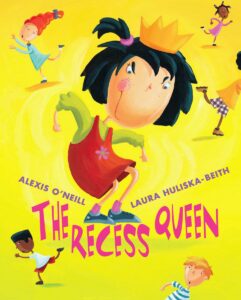
Playground dynamics often feel totally wild.
This bouncy, rhyming book tackles the concept of playground bullying.
It shows that an earnest invitation is a highly disarming tactic.
What kids notice: Kids are deeply captivated by the musical language.
Story snapshot: Mean Jean is the undisputed Recess Queen.
She dictates exactly who plays and what they play.
Then, a tiny new girl named Katie Sue arrives.
When Mean Jean confronts her, Katie Sue simply invites Jean to play.
Stunned by the inclusion, Mean Jean happily joins in.
Why this book helps: This high-energy story models an effective approach to exclusion.
Sometimes children exclude others because they do not know how to connect.
Katie Sue diffuses a tense situation with an offer of inclusive play.
Therefore, extending the circle gently replaces fear with shared joy.
Meesha Makes Friends by Tom Percival
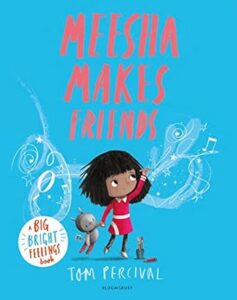
This beautiful book offers an empathetic look at social anxiety.
For some children, reading social cues feels like a foreign language.
It is a comforting read for any child who struggles with social rules.
What kids notice: Children notice the visual chaos that constantly surrounds Meesha.
Story snapshot: Meesha truly loves making things.
However, she cannot seem to make friends.
Feeling isolated at a loud party, she crafts her own paper friends.
Next, a boy named Josh notices her incredible creations.
Instead of dragging her into the group, he sits down quietly to help.
Why this book helps: Inclusive play does not always mean being loud.
This book helps kids understand that some peers need a quieter approach.
Josh models true empathy by gently changing his own play style.
Sometimes the best inclusion is simply sitting quietly beside a friend.
All Are Welcome by Alexandra Penfold
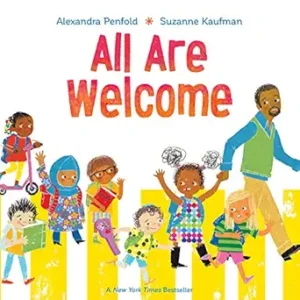
To round out this list, we look at the whole community.
This bright, happy book walks readers through a beautiful school day.
The rhyming text acts as a very comforting heartbeat.
What kids notice: The incredibly detailed pictures immediately capture their attention.
Story snapshot: Through a rhythmic refrain, the book follows a diverse group of children.
It shows kids of all backgrounds learning side-by-side.
They share unique lunches and play together in the schoolyard.
The book ends in a massive, beautiful community gathering.
Families break bread together, united by welcoming everyone.
Why this book helps: This story provides the ultimate view of inclusive play.
It helps immensely by making inclusion totally normal from day one.
It teaches kids that the default setting should always be open arms.
Therefore, a child is far less likely to leave someone out.
Put Your Child in the Heart of the Story
Reading about inclusive play is incredibly powerful.
However, magic happens when a child sees themselves practicing the virtue.
This is exactly where Scrively changes everything.
With Scrively, you can instantly create a fully custom children’s book.
You can place your child directly into a story about a playdate.
You can craft a narrative that models real, active empathy.
Consequently, it makes the concept of inclusive play truly unforgettable.
The shift from a tight duo to a trio is a big milestone.
It requires children to recognize the feelings of someone else.
It is not a skill they will master overnight.
By reading these stories, you are giving them the ultimate gift.
Keep reading, keep guiding, and watch their beautiful circle grow.