The Brave Little Pause: Helping Your Child Master the Strength of Self-Discipline
You know that breathless moment just before the storm breaks.
Specifically, it is the split second where your child’s hand hovers over a sibling’s tower of blocks. In that tiny gap exists the entire world of self-discipline.
We often talk about self-control as if it is a rigid cage.
However, it is actually a steering wheel. It is the quiet internal power that allows a child to navigate big feelings without crashing.
Ultimately, it is the “brave little pause” that transforms a reaction into a choice. Helping our children find that pause is a profound gift.
As parents, we are helping them build an internal sanctuary. When a child masters self-discipline, they learn to be “good” for their own sake.
This virtue is the foundation of their future freedom.
Consequently, it gives them the ability to say “not now” to a small distraction so they can eventually say “yes” to a much bigger dream. It is a muscle that starts out shaky, often failing under the weight of a sugary treat.
But with your steady guidance, it grows into a reliable source of character.
You show them that while they cannot always control the weather of their emotions, they can always learn to pilot their own ship.
There is magic in watching a child realize they have this power. You see it when they take a deep breath instead of stomping.
These moments are the quiet victories of childhood. While they aren’t as loud as a soccer goal, they are the true milestones of maturity.
By celebrating these small acts of restraint, you reinforce the idea that they are the masters of their own actions. As a result, their self-worth becomes rooted in their ability to govern themselves with kindness and strength.
A Library for the Developing Heart: Stories That Build Inner Strength
Lilly’s Purple Plastic Purse by Kevin Henkes
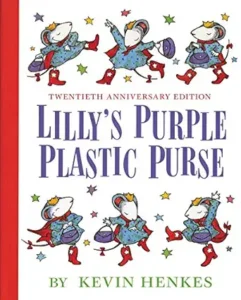
Lilly is a firecracker of a character, full of zest and school spirit.
However, her beloved new accessories lead her into a conflict with her favorite teacher.
The book vibrates with the relatability of wanting to be the center of attention.
It also captures the crushing weight of a “wait” that feels like an eternity. Kevin Henkes captures the electricity of childhood excitement with immense heart.
What kids notice: They see the glittering coins and the musical purse.
They also notice how Lilly’s drawings change from adoring to angry when she feels unheard. Finally, they feel the sting of her shame when her treasures are taken away.
Story snapshot: Lilly brings her movie star sunglasses to school but cannot wait for sharing time.
After interrupting lessons, Mr. Slinger confiscates the items. This leads Lilly to lash out in a mean drawing. When she realizes her mistake, she must find the discipline to make amends.
Why this book helps: This story discusses the “urge to share” versus the “need to listen.”
Specifically, it helps children understand that self-discipline honors the space of others. Because Lilly chooses to fix what she broke, the lesson becomes one of restoration.
It reframes the teacher as a guardian of harmony rather than an adversary of fun. Ultimately, it teaches that discipline is a bridge back to the people we care about.
Waiting Is Not Easy! by Mo Willems

Mo Willems takes a massive concept like patience and strips it down to its funniest essentials.
Elephant and Piggie are the perfect avatars for the tug-of-war between curiosity and frustration.
The book uses negative space to show the physical toll of waiting. It mirrors the agonizingly slow crawl of a clock when something wonderful is on the horizon.
What kids notice: They resonate with Gerald’s over-the-top reactions.
Additionally, they notice how his speech bubbles get larger as his patience wears thin. They love the suspense of the “surprise” and the visual payoff of the ending.
Story snapshot: Piggie has a surprise for Gerald, but he must wait. Throughout the day, Gerald is convinced the surprise will never come. Finally, as night falls, the true surprise is revealed—a breathtaking view of the Milky Way that required the sun to go down.
Why this book helps: Self-discipline is often just waiting with a good attitude. Gerald provides a mirror for how difficult that actually is. The book validates the struggle while providing a spectacular “why.”
Because of this, it teaches children that the most beautiful things cannot be rushed. It builds the delayed gratification muscle through shared humor.
It proves that the “wait” is the necessary preparation for wonder.
My Mouth Is a Volcano! by Julia Cook
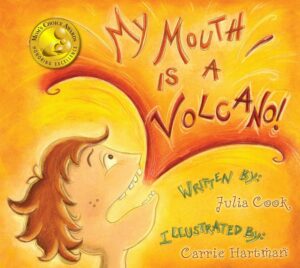
For some, the impulse to speak is a physical eruption.
Julia Cook turns this metaphor into a story about Louis, a boy whose words simply cannot wait their turn.
The prose is rhythmic and urgent, capturing the frantic energy of a child who feels their thoughts are most important. Cook treats the “volcano” with both humor and respect.
What kids notice: They notice the “grumble and rumble” in Louis’s tummy.
They also see how his words slide onto his tongue like hot lava. Furthermore, they see the frustrated faces of the people Louis interrupts, which helps build empathy.
Story snapshot: Louis’s words erupt whenever they feel like it. It isn’t until Louis himself is interrupted by other “volcanoes” that he realizes how it feels to be ignored.
Consequently, he learns a physical technique for holding his breath and “sliding” his words out later.
Why this book helps: This book provides a concrete strategy for an abstract problem.
By giving children the “breathe in, hold it” technique, it empowers them with a tool for self-regulation. It shifts the narrative from “being rude” to “managing a volcano.”
This distinction protects a child’s self-esteem. It teaches them that they are the masters of their own “lava.” Ultimately, it transforms a perceived character flaw into a manageable physical sensation.
Clark the Shark by Bruce Hale
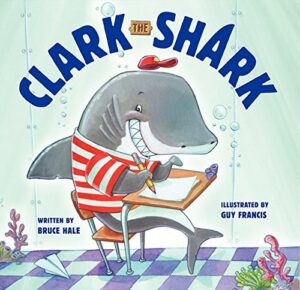
Sometimes, a lack of self-control is just being “too much.”
Clark is a shark who loves life, but his oversized enthusiasm leaves his friends feeling overwhelmed.
The book uses vibrant illustrations to show the difference between a big personality and having no boundaries. Clark’s journey is resonant because his heart is as big as his appetite.
What kids notice: They see Clark’s giant grin and his destructive energy. They also notice the weary expressions on his friends’ faces. Finally, they catch the simple, catchy rhymes Clark uses to stay on track.
Story snapshot: Clark is a boisterous student who does everything with maximum intensity.
When his friends back away, his teacher helps him understand timing. Consequently, Clark starts creating rhymes like “Stay in your own space, it’s a better place” to regulate his movements.
Why this book helps: Clark serves as a mirror for children who struggle with impulse control in social settings. It teaches them that self-discipline is about finding the right “volume.”
This book is helpful because it celebrates Clark’s zest for life. It doesn’t ask him to dull his spark. Instead, it teaches him to direct his energy so others can shine too.
This helps children embrace discipline as a tool for connection rather than a cage for their spirit.
The Girl Who Never Made Mistakes by Mark Pett and Gary Rubinstein
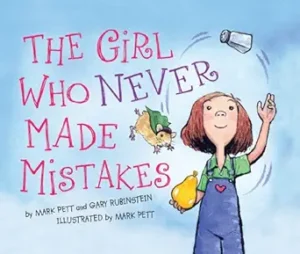
Self-discipline has a shadow side: perfectionism. Beatrice Bottomwell has never made a mistake, but that is a prison of her own making.
The book’s art is clean and precise, reflecting her rigid world until things go sideways.
It explores the idea that true self-regulation includes handling failure with grace. It is a story about the discipline of letting go.
What kids notice: First, they see the “perfection” of Beatrice’s life. Then, they feel the tension as she prepares for a talent show. Finally, they witness the giant, messy mistake and her surprising response.
Story snapshot: Beatrice is famous for being perfect.
But one day, she almost makes a mistake, and the fear begins to paralyze her.
When she finally makes a public blunder, she discovers that the world doesn’t end. Instead, she learns to laugh and feels free to just be a kid.
Why this book helps: This story redefines self-discipline as the courage to be imperfect.
It teaches that the ultimate form of self-control is controlling your reaction to the unexpected.
For many, fear leads to an avoidant kind of discipline. This book encourages them to loosen the reins.
When we stop trying to control every outcome, we gain inner peace. It helps children transition from a rigid state to a resilient state of growth. It teaches them that the “pause” can be used to show themselves mercy.
I Am Peace: A Book of Mindfulness by Susan Verde
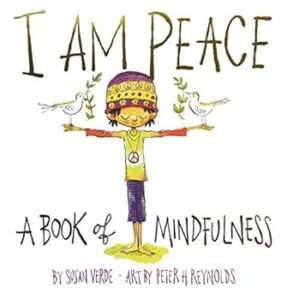
Self-discipline often begins with the breath. This poetic book introduces mindfulness as the foundation of self-control.
It doesn’t focus on “doing.” Instead, it focuses on “being.” The light, airy illustrations provide a visual sense of the mental space that mindfulness creates. It is a gentle invitation to slow down and notice the present moment.
What kids notice: They feel the slowing of the pace.
They notice simple actions—touching the ground or smelling a flower—that help the protagonist find their center. The “peace” in the title becomes something they can feel in their own bodies.
Story snapshot: This is a guided journey through mindfulness. It follows a child who feels overwhelmed by the “what ifs” of the future.
By focusing on the present moment and breathing, the child finds inner stability. Consequently, they learn they have the power to choose how they interact with the world.
Why this book helps: Mindfulness is the “operating system” for self-discipline.
Without the ability to notice thoughts in real-time, we cannot regulate them. This book teaches children to see thoughts as passing clouds.
By practicing these techniques, they develop the “pause” necessary for self-control. It builds a lifelong capacity for emotional health.
Ultimately, it shows that self-discipline isn’t a struggle against oneself. Rather, it is a gentle alignment with the present.
The Bad Seed by Jory John
Can a “bad” seed decide to be “good”? This story tackles willpower and the conscious choice to change.
The “Bad Seed” has a reputation he leans into. However, he eventually realizes that being grumpy is lonely.
The retro art style shows the seed’s journey from a hardened character to someone who is actively trying to be better. It is a look at the grit it takes to change your mind.
What kids notice: They love the seed’s antics, like lying or never washing his hands. But they also notice the sadness in his eyes when he explains his past. Finally, they see the visible effort it takes for him to be kind.
Story snapshot: Traumatic events turned a regular seed into a hardened character. One day, he decides he doesn’t want to be angry anymore. He chooses to be happy. It isn’t an overnight transformation. However, he makes a consistent effort every day, and that makes all the difference.
Why this book helps: This is the most honest book about self-discipline for children.
It acknowledges that changing behavior is hard work. Furthermore, it admits you won’t get it right every time. It highlights the power of “choice”—the ultimate expression of discipline.
The book teaches children that they are not defined by their past. They have the agency to rewrite their story through small actions. It reinforces the idea that discipline is a daily practice, not a destination.
Soda Pop Head by Julia Cook

Anger is the most common enemy of self-discipline. Lester is a “Soda Pop Head.” When things don’t go his way, he gets “shook up” until he finally pops his top.
Cook uses the imagery of a soda bottle to explain the buildup of frustration. It turns a scary, overwhelming feeling into something that can be understood and managed with practice.
What kids notice: They see the “fizz” building up inside Lester. They recognize physical signs of anger, like a red face.
They also pay close attention to the “Push, Pull, Dangle” technique his dad teaches him.
Story snapshot: Lester has a quick temper. Because he doesn’t know how to let the “fizz” out slowly, he has a giant meltdown.
His father teaches him that he is responsible for his own “cap.” Consequently, he teaches Lester a physical exercise to release pressure in a healthy way.
Why this book helps: This book provides a physical metaphor for a complex problem. It helps children visualize anger as something happening to them that they can manage.
The “soda pop” analogy is effective because kids understand how a shaken bottle works. It teaches the importance of “venting” frustration in small ways.
This builds emotional self-regulation. It shows that self-discipline is often about small, preventative measures. Lester isn’t told to stop feeling angry; he is taught how to handle it with grace.
Put Your Child in the Heart of the Story
While these classics offer incredible lessons, there is a special magic that happens when your child is the hero.
At Scrively, we believe that the most powerful way to teach a virtue is to weave it into your child’s identity. Imagine a story where your child is the one learning to manage their “volcano.”
By personalizing these journeys, you remove the distance between the lesson and the learner.
Your child sees themselves overcoming impulses and reaping the rewards of self-control.
This isn’t just reading; it is a rehearsal for life. When they see themselves as the hero of their own discipline, the lesson sticks in a way no other book can match.
It becomes a memory of who they are, rather than just something they read.
The journey toward self-discipline is rarely a straight line. It is a path filled with stumbles and messy outbursts. However, every step is progress.
By surrounding your child with stories that celebrate the “pause,” you give them the map they need. You teach them that strength isn’t found in how loud you can yell. Instead, it is found in the quiet resolve to do what is right.
So, take a deep breath, open a book, and enjoy watching your child discover their inner strength.
You are building a lifetime of freedom and peace, one story at a time. The seeds you plant today will grow into the character that carries them through tomorrow.