Helping Your Child Find Joy in Life’s Smallest Moments
You know that heavy, cluttered feeling after a birthday party.
Wrapping paper lies in a chaotic sea on the floor. In that moment, you don’t hear a “thank you.” Instead, you hear a question about the next gift.
It is a moment that stings. It makes you wonder about the seeds of appreciation you have sown. Specifically, you want your children to see the world differently.
You want them to see gifts, not a catalog of items to acquire.
You want them to feel a quiet hum of joy. You want them to know the grace of gratitude.
Gratitude is more than a polite habit. It is a lens for the soul. This lens transforms the ordinary into the extraordinary.
When you sit with your child, ask what made their heart happy.
By doing this, you are training their eyes to look for the light. You are teaching them that happiness is not a destination.
It is not something they get once they own a specific toy. Instead, it is a companion for the journey. Consequently, this revolution begins in your small, shared moments.
In our world, the “more” culture is relentless. It shouts at children from every screen.
It tells them they are lacking. Moreover, it suggests that satisfaction is one purchase away.
To counter this, we need stories that whisper a different truth. We need narratives that celebrate a shared soup or a rainy ride. These stories offer a soft place for hearts to land.
They provide the language your child needs. Therefore, reading becomes an act of reclaiming their perspective.
This journey into thankfulness is one you take together. You travel through pages that stay with you. It is about building a family culture of appreciation. As you explore these titles, you will find chances to pause.
You will learn to notice the abundance at your table. You are not just reading; you are building a foundation of contentment.
This foundation will serve them forever. Let us look at stories that help you turn the page from wanting to seeing.
A Curated Library of Appreciation: Books That Bloom with Gratitude
Last Stop on Market Street by Matt de la Peña
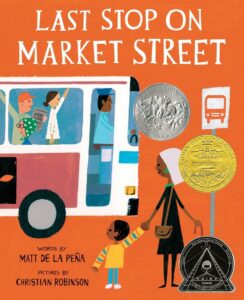
This story has a soulful, rhythmic quality. It feels like a deep breath for parents. It captures the tension between desire and redirection.
The urban setting is vibrant and alive. Specifically, it pulses with the music of city life.
You can feel the vibration of the bus. You can hear the strumming of the guitar. The characters move through their routine with quiet, dignified joy.
What kids notice: Children love the energetic illustrations. They notice CJ’s questions about why he lacks a car.
Most importantly, they see his face change. He begins to notice the “magic” his nana points out in the city.
Story snapshot: CJ and his Nana ride the bus after church. They are going to volunteer at a soup kitchen.
Along the way, CJ complains about what they lack. Nana answers every complaint with a perspective shift. She reveals the beauty hidden in their surroundings.
Why this book helps: This book helps children understand that gratitude is an active choice. It shows that thankfulness is a matter of perspective. Specifically, it validates feelings of envy.
Then, it gently shows how to find beauty in overlooked places. It models how to foster a thankful heart. By anchoring gratitude in service, it makes the virtue feel tangible and deeply human.
Thank You, Omu! by Oge Mora

The warmth of this book radiates like steam from a pot. It is a story about the circular nature of generosity.
A heart that gives freely becomes the most full. The collage-style illustrations create a sense of community. These visuals remind us that we are all interconnected.
It feels like a celebration of neighborhood love. It emphasizes that the best things are those we give away.
What kids notice: Little ones are captivated by the recurring “Knock! Knock!” They watch the stew disappear as more people arrive.
They love seeing the different neighbors. They enjoy the bright, colorful scraps of paper that make up Omu’s world.
Story snapshot: Omu makes a thick red stew for her dinner. The scent wafts through the neighborhood.
One by one, neighbors follow their noses to her door. Omu shares a bowl with everyone until her pot is empty. Surprisingly, her kindness returns to her in a beautiful way.
Why this book helps: This story illustrates the link between gratitude and generosity.
It shows that being thankful makes us more willing to share. Consequently, it teaches kids that giving creates a new kind of abundance.
This abundance is found in friendship. It helps children recognize that gratitude is an action. It frames thankfulness as a tool that turns strangers into neighbors.
The Thankful Book by Todd Parr
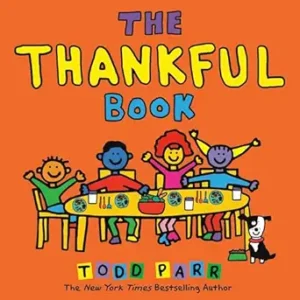
In the world of Todd Parr, gratitude is accessible to everyone.
This book is a joyful romp through simple pleasures. It covers everything from family to silly underpants. It levels the playing field. As a result, thankfulness feels like a fun game.
The primary colors make it a favorite for young readers. However, the message resonates with everyone who forgets to be glad for the basics.
What kids notice: The silly humor is the main attraction. Children giggle at being thankful for ears or feet.
The diverse, colorful characters make every child feel included. Because of this, kids stay engaged with the message of appreciation.
Story snapshot: The book moves through simple statements about things to be thankful for.
These range from teachers to bubbles and shadows. Every page is delivered with Parr’s signature warmth. It is a simple list of reasons to be glad.
Why this book helps: This book helps children build a “gratitude vocabulary.” It highlights that nothing is too small to be appreciated.
Moreover, it encourages kids to look at their environment with wonder. For parents, it provides a template for a daily practice. It turns noticing into a playful part of the day.
By validating small joys, it reinforces that thankfulness is a state of mind.
Bear Says Thanks by Karma Wilson
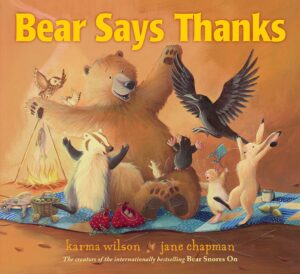
There is a cozy, rhythmic cadence to this book. It feels like a favorite blanket. In this story, the focus is on the richness of friendship.
It explores the feeling of having nothing to contribute. However, it shows that your presence is a gift.
The forest setting is lush and inviting. It makes the reader want to join the feast with Bear and his friends.
What kids notice: Children love the repetitive refrain of “Bear says thanks.” They notice each animal bringing a different treat.
They also see Bear’s expressions change from sadness to joy. They feel the warmth of the community gathered in the cave.
Story snapshot: Bear wants to host a feast, but his cupboards are empty.
As his friends arrive with food, Bear grows distressed. He feels he has nothing to give in return. Fortunately, his friends remind him that his stories are the best feast of all.
Why this book helps: This book teaches that gratitude is not just about material things. It emphasizes the value of the people in our lives.
It helps soothe the anxiety of “not having enough.” Specifically, it teaches kids to be thankful for their community.
It helps them see that being a friend is a profound contribution. This story frames thankfulness as a social glue that strengthens bonds.
The Table Where Rich People Sit by Byrd Baylor

This book is a poetic journey that challenges the definition of wealth. It is written with a sparse beauty.
It’s a story about a family discussing their lack of money. However, they realize their lives are overflowing with a different currency.
This currency is found in mountain air and moonlit nights. It feels grounded in the earth and the sky. It is a timeless lesson.
What kids notice: Older children notice the serious way the family discusses wealth. They are intrigued by putting a value on a hawk’s flight. They pick up on the girl’s initial frustration.
Eventually, they see her realization that her family is actually rich.
Story snapshot: A young girl is upset that her family is “poor.” She calls a meeting to demand more money.
Her parents respond by calculating the value of their experiences. These include the smell of rain and time spent together. Consequently, the family realizes they are wealthier than any billionaire.
Why this book helps: This is a powerful tool for shifting a focus away from consumerism. It points children toward the natural world.
Most importantly, it helps them differentiate between “price” and “value.” This distinction is often lost today.
It encourages a deep gratitude for the environment. For parents, it provides a framework for talking about family priorities. It teaches that thankfulness is the ultimate equalizer.
Apple Cake: A Gratitude by Dawn Casey
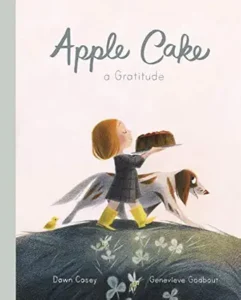
Simple and earth-centered, this book follows a girl gathering ingredients. It is a litany of thanks from soil to treat.
The illustrations are warm and peaceful. It feels like a slow Sunday morning. It celebrates the miracle of growth and shared work.
Consequently, it turns a simple recipe into a celebration of life. It is a perfect story for mindful reading.
What kids notice: Children are drawn to the gentle repetition. They see the connection between nature and the food they eat.
They enjoy following the girl and her dog through the farm. They notice the small details of the animals and plants.
Story snapshot: A young girl walks through the countryside. She says “thank you” to the hedge, the bees, and the tree.
She gathers what she needs to bake a cake. The story concludes with a warm, shared meal where everyone expresses their final thanks.
Why this book helps: This book helps children understand “interconnected gratitude.” It teaches them to see the natural processes behind finished products.
This builds a deeper, more mindful form of thankfulness. It isn’t just about the cake; it’s about the web of life.
Furthermore, it is a great way to introduce thanks before meals. It turns a kitchen task into a sacred act of appreciation.
Giving Thanks: A Native American Good Morning Message by Chief Jake Swamp
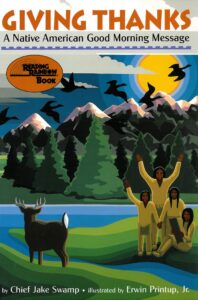
This book is a breathtaking tribute to the natural world. It is a traditional message of gratitude passed down for generations.
The language is reverent and rhythmic. It acknowledges every element of the environment as vital. It provides a profound sense of scale.
Consequently, it helps children see themselves as cherished parts of a magnificent creation.
What kids notice: Children respond to the respect in the narrator’s voice. They are captivated by the stunning illustrations of nature.
They notice how every part of nature is given a specific moment of thanks. They feel the peace of the “Good Morning Message.”
Story snapshot: This book is a poetic version of the Mohawk “Thanksgiving Address.” It is a series of greetings to the natural world. Traditionally, it is recited at the start of each day. It honors the sun, moon, stars, and plants that sustain us.
Why this book helps: This book introduces a perspective of gratitude that is ancestral. It teaches that thankfulness is a way of showing respect. It broadens their understanding of being grateful.
Specifically, it moves beyond personal items to a global scale. It helps foster a sense of responsibility toward nature.
This responsibility is rooted in the recognition of nature’s gifts. It grounds a child’s day in awe.
Sylvester and the Magic Pebble by William Steig
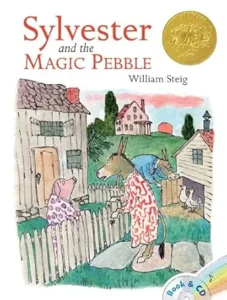
This is a profound story about restoring gratitude for the ordinary. Sylvester goes through a terrifying ordeal.
He loses his voice, his movement, and his family. He is miraculously returned to them in the end.
The emotional weight makes the final reunion deeply moving. It reminds us that being together is the greatest magic. It is a classic for a reason.
What kids notice: Children are often worried about Sylvester being a rock. They feel the sadness of his parents as seasons change.
Finally, they experience a surge of joy when he returns to his true form. They notice the power of a simple wish.
Story snapshot: Sylvester the donkey finds a magic pebble. A lion frightens him, and he wishes he were a rock.
He remains a rock for a long time. Eventually, a lucky coincidence allows him to return to his family.
He realizes he has everything he ever needed.
Why this book helps: This story helps children understand the danger of wishing for the wrong things. It serves as a reminder to be thankful for “boring” parts of life.
These include our bodies and our voices. It teaches that gratitude is felt most deeply after a loss.
For parents, it is a reminder to cherish our children’s presence. Their presence is the greatest gift. It frames gratitude as the joy of the present moment.
Put Your Child in the Heart of the Story
While these books provide a window into gratitude, magic happens when your child is the hero.
At Scrively, we believe children learn best when they see themselves. Imagine a “thank you” on the page addressed to their real-life helpers.
Our personalized stories allow you to weave your child’s name into a high-quality book. You can include their favorite toys and their local park.
Imagine the light in your child’s eyes when they read their own story.
By making gratitude personal, you make it permanent. You aren’t just teaching a concept. Instead, you are helping them document their reasons to be glad. This creates a keepsake for years to come.
The journey toward a grateful heart is a lifelong path. We are honored to walk with you.
Whether you read a classic or a custom Scrively story, you are building resilience.
You are fostering the contentment that carries a child through life. Gratitude is the quiet strength that turns “enough” into “more.” It is the grace that finds beauty in the broken.
As you tuck your child in tonight, take a moment to be thankful. Be thankful for this shared journey and the stories that guide us. You are doing a wonderful job of growing a grateful heart.
That is something to be truly thankful for today.