Finding Wonder in an Ordinary Day: 8 Children’s Books About Gratitude
Some days feel too ordinary to remember. Breakfast spills, shoes disappear, the drive takes forever, and by bedtime everyone is tired. When you ask your child about their day, “Nothing” may be the only answer they can find.
Yet a day does not have to be easy or exciting to hold something worth noticing. A curl of steam above a bowl, the sound of a neighbor calling hello, a bird balancing on a wire: small moments can give a child somewhere gentle to rest their attention.
Gratitude begins there. It is more than a polite thank-you or a demand to feel happy. It is the freedom to notice what is good while leaving room for disappointment, boredom, and worry. You can help your child practice that freedom without turning it into another assignment.
These children’s books about gratitude invite you both to look again at familiar places. Some wander outside. Some stay close to home. Each offers a different way to discover that an ordinary day can be full of quiet gifts.
Children’s Books That Make Everyday Wonder Visible
Choose the story that meets your child where they are. A child who loves collecting tiny treasures may want a noticing walk. A child whose day has gone wrong may need a story that allows the hard part to stay real. You do not need to read all eight at once; one good question after one good book is plenty.
Tiny, Perfect Things by M.H. Clark
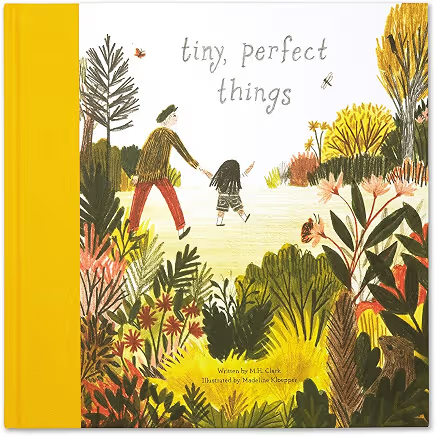
There is a lovely kind of walk that takes twice as long as expected because a child stops every few steps. In this book, a child and a grandfather let the neighborhood set their pace. They find plenty to admire without traveling anywhere remarkable.
Madeline Kloepper’s detailed illustrations reward a lingering look. You and your child can return to a spread and find something that slipped past you the first time, just as you might on a real walk together.
What kids notice: A small discovery matters more when somebody else slows down to see it, too. The grandfather’s attention turns a familiar route into shared time.
Story snapshot: On a neighborhood walk, a child and grandfather discover tiny things, including a spiderweb, a fallen leaf, and a ladybug. Their ordinary outing becomes an adventure of looking closely.
Why this book helps: It gives gratitude a doable shape. After reading, you might ask, “What was one tiny perfect thing on our way home?” There is no need for a profound answer. A bright pebble counts.
Wonder Walkers by Micha Archer
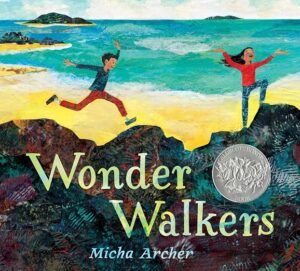
Children are wonderfully good at asking questions that grown-ups have stopped asking. What might a tree feel like from the inside? How big can the sky seem when you lie beneath it? This book welcomes that curious way of seeing.
Archer’s layered collage art makes the natural world feel textured and alive. The pleasure is in walking, wondering, and leaving some questions open rather than rushing toward correct answers.
What kids notice: The children lead with curiosity. A walk becomes more interesting because they give themselves permission to imagine and ask.
Story snapshot: Two young explorers wander through nature, using playful questions and fresh comparisons to notice the world around them.
Why this book helps: Wonder can come before gratitude. You might take a “question walk” and let your child choose one thing to puzzle over together. Appreciation often grows when you stay with the question a little longer.
Daniel’s Good Day by Micha Archer
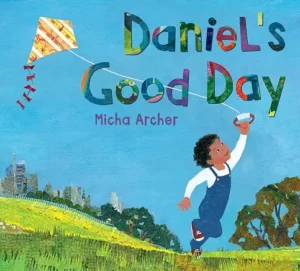
Your child may assume that a good day has one definition: a favorite snack, a canceled chore, or extra playground time. Daniel’s neighborhood gently widens the idea. He discovers that the people around him each hope for something a little different.
The bright community scenes make it easy to pause and talk about the lives surrounding your own. They also invite a child to see how a good day can be made up of modest, particular moments.
What kids notice: Different neighbors look forward to different things. A child can enjoy their own favorite moments while becoming curious about someone else’s.
Story snapshot: Daniel asks people in his neighborhood what makes a good day. Their varied answers help him notice the many simple pleasures around him.
Why this book helps: Gratitude need not sound the same in every family member’s voice. At dinner, each person could name a different small thing that made today feel good, with no pressure to agree.
A Stone Sat Still by Brendan Wenzel
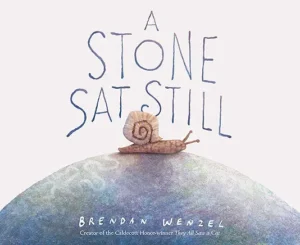
A stone may be the last thing you would expect to hold a child’s attention. Wenzel invites readers to stay with one anyway. To the creatures that encounter it, this unassuming object can be useful, comforting, imposing, or small.
The book shifts perspective with a quiet sense of surprise. It is especially good for the child who says there is nothing interesting nearby; the story suggests that attention can change the view without changing the place.
What kids notice: The same stone means different things to different animals. Children can compare what each creature sees and imagine how their own size or needs might change a familiar scene.
Story snapshot: A stone remains in place while animals interact with it in different ways, revealing many sides of one seemingly ordinary part of the landscape.
Why this book helps: Gratitude sometimes starts by asking whose life is touched by the ordinary things around us. Look at a tree, bench, or patch of shade together and wonder who else might welcome it.
The Hike by Alison Farrell

A nature outing with children rarely unfolds as a silent, perfectly paced stroll. There are questions, detours, muddy spots, and discoveries that make you forget how far you meant to go. Farrell brings that energetic feeling to the page.
The story of three girls exploring outdoors feels like an invitation to treat the nearby world as worthy of adventure. You can share its spirit even if your version of a hike is a short loop around the block.
What kids notice: There is a lot to find when friends explore together. Their interests and reactions give the outing its character as much as the scenery does.
Story snapshot: Three girls set out on a hike, encountering the pleasures and challenges of exploring nature close to home.
Why this book helps: Appreciation grows through participation. Let your child choose the path, carry a little notebook, or point out the most surprising thing they saw. A small trip can belong to them.
Outside In by Deborah Underwood
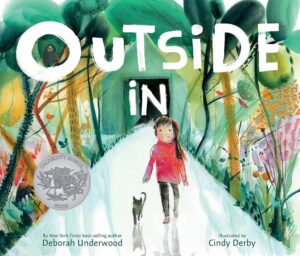
When weather, schedules, or plain exhaustion keep you inside, nature can feel far away. This lyrical book brings it close again. Cindy Derby’s expressive art helps make the ordinary contact between indoors and outdoors feel quietly astonishing.
You might read it on a rainy afternoon with your child beside a window. There is no need to insist that they go outside to understand it; the book makes room for noticing what reaches them right where they sit.
What kids notice: Outside does not vanish when we close the door. Light, air, sounds, and the things we use connect our rooms with a larger world.
Story snapshot: A poetic exploration shows the many ways the natural world remains part of our lives even as we spend time inside.
Why this book helps: It makes gratitude accessible on a low-energy day. Ask your child what outside brought into the room today, perhaps a patch of sunlight or the sound of rain. Their answer can be small.
A Good Day by Kevin Henkes
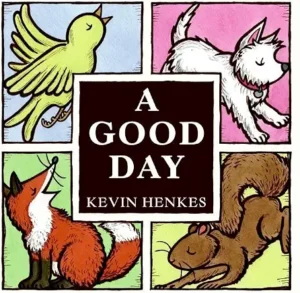
For a child who has lost something or had a frustrating morning, a cheerful lesson about being thankful can feel unfair. Henkes begins with things going wrong for several animal characters. That honesty is what makes the change in mood feel welcome.
The spare art and simple rhythm give young readers space to feel each setback. You can sit with the disappointment before wondering what else the day might still hold.
What kids notice: A bad moment feels big while it is happening, and another moment can arrive later. One feeling does not have to describe the whole day.
Story snapshot: A bird, fox, dog, and squirrel each face a small mishap. As their day unfolds, their fortunes shift, and what seemed like a bad day becomes a good one.
Why this book helps: It leaves room for both gratitude and honest frustration. Instead of saying “Look on the bright side,” you might say, “That part was hard. Was there any part you want to remember, too?”
Last Stop on Market Street by Matt de la Peña
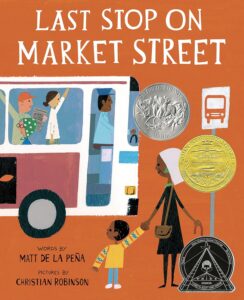
CJ has questions about the bus ride he takes with his grandmother. Nana does not brush those questions aside. As they travel through their city, she helps him notice music, people, and beauty that can be missed when you are thinking only about what you lack.
Christian Robinson’s vivid illustrations make the bus and its passengers feel full of life. This is a story to discuss with care: gratitude is not a reason to dismiss a child’s wish or to pretend that people’s circumstances are all the same.
What kids notice: A familiar route holds many people with their own stories. Nana’s way of paying attention changes how CJ experiences the ride.
Story snapshot: CJ and Nana ride the bus across town after church and continue toward a community meal, noticing the world and people around them along the way.
Why this book helps: It connects appreciation with relationship and community. Ask what CJ first notices, what Nana notices, and what your child might notice on a regular trip you take together.
Put Your Child in the Heart of the Story
One reason these books stay with children is that they make room for a reader’s own life. The sidewalk in a story might remind your child of the walk to school. A rainy window might look like the one beside their bed. Once they recognize a piece of their world, the next question comes naturally: What would I notice if I were there?
A personalized Scrively story can carry that invitation further by placing your child inside an everyday adventure built around gratitude. They might follow a trail of tiny discoveries through their neighborhood, thank someone who helped them, or find one good thing at the end of a difficult day. Their name and familiar details can make the reflection feel personal without requiring a perfect mood or a perfect child.
You can also make a simple story together without any materials. Start with the most ordinary part of today: waiting for the bus, washing a cup, walking to the mailbox. Let your child choose one sound, one color, and one person to include. Then ask what their story-self might have missed the first time. Listen closely; their answer may show you something you missed, too.
Let the Small Things Be Enough
You do not need to turn every meal into a gratitude exercise or persuade your child that an upsetting day was secretly wonderful. Sometimes the kindest thing you can do is acknowledge the hard part, then stay open to a small pleasure when it appears.
Read one of these books, take a slower walk, or look out the window together for a minute. If your child points to an ant, a cloud, or a neighbor waving, follow their gaze. Ordinary days become richer when someone we love is willing to notice with us.