Best Technology Books for Future Inventors
Many children who grow up to invent, design, or build don’t start with tools or technical skills.
They start with questions. How does this work? Why does that happen? What if I tried it a different way?
That natural curiosity is the real beginning of technology learning.
When we talk about “future inventors,” we’re not talking about kids who already know how to code or build machines.
We’re talking about children who like to tinker, imagine, take things apart (sometimes accidentally), and think creatively about solving problems.
For many parents, technology can feel intimidating — especially when it’s often linked to screens, apps, and early performance pressure.
But technology, at its core, is simply about creating tools that help people. And one of the safest, most inspiring ways to explore that idea is through books.
Stories about inventing, designing, and experimenting allow kids to explore big ideas without pressure.
Books create space for imagination, mistakes, and persistence — all essential qualities for innovators of any age.
The technology books below focus on creativity over correctness, curiosity over complexity, and confidence over achievement. They show kids that inventing is playful, human, and open to everyone.
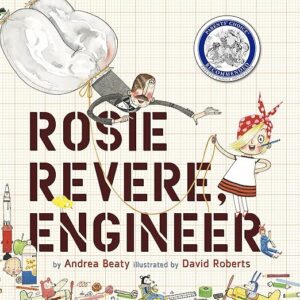
Rosie Revere, Engineer — Andrea Beaty
Core Themes:
• Persistence and creativity
• Learning from mistakes
• Confidence through trying
Story Snapshot:
Rosie loves to invent, but she hides her creations after a failure makes her doubt herself. With encouragement, she learns that mistakes are part of the process.
How this book supports future inventors:
This story normalizes failure as a step toward learning. It helps kids see that ideas don’t have to work perfectly the first time to be valuable or meaningful.

Ada Twist, Scientist — Andrea Beaty
Core Themes:
• Curiosity and questioning
• Observation and experimentation
• Joy in discovery
Story Snapshot:
Ada asks questions nonstop as she explores the world around her, determined to understand how things work.
How this book supports future inventors:
By celebrating curiosity, this book encourages kids to ask “why” without fear. It reinforces that questioning is a strength, not a distraction.

If I Built a House — Chris Van Dusen
Core Themes:
• Imagination and design
• Creative problem-solving
• Big ideas
Story Snapshot:
A child imagines designing the ultimate house filled with creative, futuristic features.
How this book supports future inventors:
This story invites kids to dream without limits. It reinforces that innovation often begins with imagination before practicality.
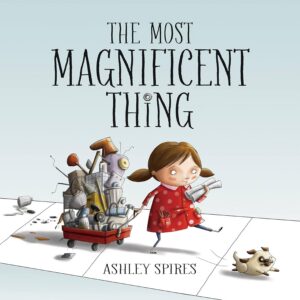
The Most Magnificent Thing — Ashley Spires
Core Themes:
• Frustration and perseverance
• Trial and error
• Emotional resilience
Story Snapshot:
A girl sets out to make the most magnificent thing — but it doesn’t turn out the way she expects.
How this book supports future inventors:
This story validates frustration while modeling healthy ways to keep going. It teaches that stepping back can be just as important as pushing forward.

What Do You Do With an Idea? — Kobi Yamada
Core Themes:
• Creativity and courage
• Believing in ideas
• Growth and confidence
Story Snapshot:
A child nurtures a fragile idea, learning to protect and grow it despite doubt.
How this book supports future inventors:
The book shows that ideas often start small and uncertain. It helps kids understand that believing in an idea is part of bringing it to life.

The Darkest Dark — Chris Hadfield
Core Themes:
• Curiosity about science
• Facing fears
• Wonder and exploration
Story Snapshot:
Inspired by real astronaut Chris Hadfield, this story follows a child whose fear of the dark transforms into fascination with space.
How this book supports future inventors:
It connects curiosity with courage, showing kids that interests can grow from unexpected places — even fears.
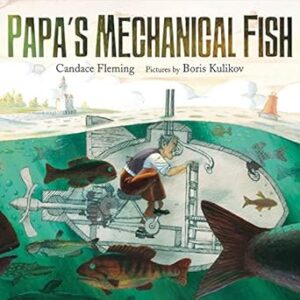
Papa’s Mechanical Fish — Candace Fleming
Core Themes:
• Engineering through persistence
• Family support
• Iteration and improvement
Story Snapshot:
Inspired by the true story of the inventor of the submarine, this book follows a father who keeps improving his invention.
How this book supports future inventors:
The story highlights patience and repeated attempts, helping kids see that big inventions often take many tries.
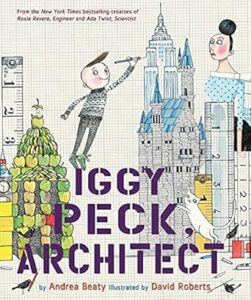
Iggy Peck, Architect — Andrea Beaty
Core Themes:
• Design and creativity
• Problem-solving
• Confidence in interests
Story Snapshot:
Iggy loves building structures, even when others don’t understand his passion.
How this book supports future inventors:
It reinforces that loving how things are built is something to be proud of, even if it looks different from others’ interests.
—-
One of the most important things to remember about technology learning is that it looks different for every child.
Some kids are drawn to building towers, others to drawing plans, others to imagining how something could work rather than actually making it yet. All of these paths matter.
It’s easy to assume that interest in technology has to show up as advanced skills or early mastery.
In reality, the foundation of invention is much quieter. It shows up in curiosity, persistence, and the willingness to try again after something doesn’t work the way you hoped.
Books help reinforce this mindset in a powerful way.
They allow children to step inside another character’s thinking, to see how ideas form, stall, change, and grow.
When kids hear stories about inventors who struggle, get frustrated, or need help, they learn that those moments are not failures — they are part of the process.
Shared reading also gives caregivers a chance to model curiosity alongside their children. You don’t need to explain how everything works.
Simply wondering aloud — “Why do you think that didn’t work?” or “What would you try next?” — sends a powerful message that learning is something we do together.
Another benefit of technology-focused stories is that they keep the emphasis on people.
Technology isn’t presented as cold or complicated; it’s shown as something created to solve problems, help others, or make life more interesting.
This human-centered approach helps children understand that inventing is about empathy as much as intelligence.
It’s also worth remembering that not every child who enjoys these books will grow up to be an engineer or designer — and that’s perfectly okay. The real value lies in building confidence, creative thinking, and comfort with problem-solving. Those skills carry into every area of life, no matter the path a child chooses.
When children are allowed to explore ideas without pressure, they’re more likely to stay curious longer. They learn that trying, adjusting, and imagining are worthwhile on their own — not just when there’s a perfect outcome.
By keeping technology learning playful, story-based, and relationship-driven, you’re helping children build a mindset that will serve them well far beyond any single skill or subject.
“`
Technology learning doesn’t need to start with screens, instructions, or expectations. It starts with curiosity, imagination, and the freedom to experiment.
Books allow kids to explore how ideas form, change, and grow — all within a safe, pressure-free space.
Rereading favorite stories, imagining new inventions, and talking about “what if” moments help build confidence naturally.
As children grow, their ideas often evolve into stories, designs, and creative projects of their own.
Platforms like Scrively exist to support that long creative journey, offering space for kids to explore storytelling and imagination when they’re ready.
For now, the most important thing is to follow curiosity wherever it leads — and to remind kids that every great invention begins with a simple idea.