The Best Children’s Books for Teaching Fairness, Equity, and Justice
You’re at the park. The “Great Blue Slide Negotiation” is in full swing.
One child has been at the top for an eternity.
Meanwhile, a line of impatient toddlers vibrates with indignation below. Suddenly, a cry rings out like a tiny siren: “That’s not fair!”
In that moment, fairness isn’t an abstract concept. It is a visceral sense of cosmic imbalance.
To a child, fairness usually means “I want my turn right now.” It is a noisy starting point for a lifelong journey toward understanding justice. However, it is also a very natural one.
As parents, we want to move them beyond this “me-first” stage. We want them to see that fairness isn’t just about everyone getting the exact same thing.
Instead, it is about making sure everyone has what they need to thrive. It is about standing up when something feels wrong, even if it doesn’t affect us.
But how do you explain systemic equity to someone who won’t share the red crayon?
You don’t do it with a lecture. Instead, you use a story.
Books provide a safe “rehearsal space” for these big ideas. They allow kids to look at a situation from the outside and ask, “Is that right?”
When we read about characters navigating unfairness, kids practice empathy.
They can see the ripples of a kind act without their own big emotions clouding the view. This turns a “teaching moment” into an “imagining moment.” That is where the real growth happens.
Here are some of the best books to help your child explore the complex world of fairness and justice. These stories move from the sandbox to the big wide world.
The Sour Grape — Jory John and Pete Oswald
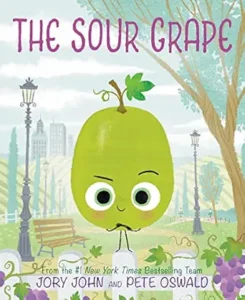
The Sour Grape holds a grudge like it is a prized possession. He believes the world has treated him unfairly.
As a result, he has become quite sour. He spends his days keeping a literal list of every slight. This continues until a small realization forces him to look in the mirror. He discovers he hasn’t been the fairest judge of others either.
This story offers a brilliant look at how our own perspective can warp our sense of justice.
It is funny and lighthearted. However, it carries a punchy message about forgiveness. It helps kids see that being “fair” also means being kind. It reminds us to give others the benefit of the doubt.
What kids notice in this story:
Children usually giggle at the Grape’s “grudge gallery.” They notice how lonely he gets when he only focuses on what others did wrong. They see his face change when he finally smiles.
Story snapshot:
A grape turns sour after a misunderstanding at his birthday party. After a long time of being grumpy, he learns that life is sweeter when you practice gratitude. He discovers that fairness starts with a kind heart.
Why this book helps:
It teaches kids that fairness isn’t just about how others treat you. It is also about the grace and patience you extend back to the world.
A Hat for Mrs. Goldman — Michelle Edwards and G. Brian Karas
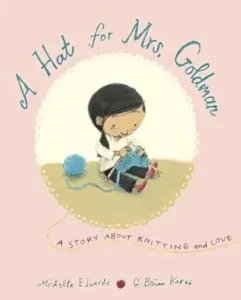
Mrs. Goldman spends her time knitting hats for everyone in the neighborhood. She wants to keep them warm.
When Sophia realizes that Mrs. Goldman doesn’t have a hat of her own, she decides to make one. But there is a problem. Sophia isn’t a master knitter. Her attempt is full of holes, yet her intent is pure gold.
This is a quiet exploration of equity. It shows the importance of looking out for those who care for everyone else.
Justice can be as simple as noticing a need and doing your best to fill it. Sophia sees an imbalance. The hat-maker has no hat. Therefore, she takes action to correct it.
What kids notice in this story:
Kids often point out the “pom-poms” Sophia uses to cover the holes. They notice the warm feeling of the neighborhood. They see how everyone cares for one another in small ways.
Story snapshot:
Sophia wants to give back to her kind neighbor who knits for the whole community. Although she struggles to knit, she learns that the most “fair” gifts come from the heart.
Why this book helps:
It introduces the idea of “restorative” fairness. It encourages children to recognize when someone is lacking and take action to make things right.
Equality’s Call — Deborah Diesen and Magdalena Mora
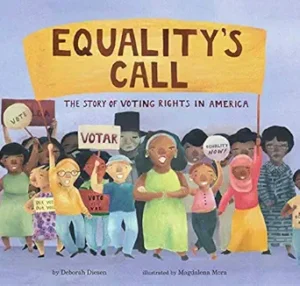
This book takes a historical approach. It traces the journey of voting rights in the United States.
The author uses a rhythmic, poetic tone to explain a big idea.
While the promise of “equality for all” existed from the start, it took a long time to become real. Brave voices had to fight to make it a reality for everyone.
It is a powerful way to introduce systemic justice. It helps children understand that sometimes rules are unfair. When that happens, the rules must change.
The refrain “A right isn’t right ’til it’s granted to all” is an impactful line. It stays with young readers long after the book is closed.
What kids notice in this story:
The illustrations show a changing world over time. Kids notice the different types of people standing up to be heard.
They often react strongly to the idea that some people were once excluded.
Story snapshot:
This is a lyrical history of the fight for the right to vote. It highlights that justice is an ongoing process. It is fueled by people who refuse to accept unfairness.
Why this book helps:
It frames justice as a collective responsibility. It shows that standing up for others is a vital part of being a good citizen.
The Big Umbrella — Amy June Bates and Juniper Bates
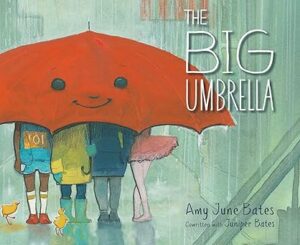
The concept here is very simple. There is a giant red umbrella. When it starts to rain, the umbrella opens wide.
No matter how many people or animals try to fit under it, the umbrella grows. It accommodates everyone. It doesn’t matter what they look like. There is always room.
This is a perfect metaphor for inclusion. It shows that fairness isn’t about being first. Instead, it is about making the circle wider. It is a gentle way to talk about how we treat strangers.
The story helps kids understand the beauty of sharing our resources with everyone.
What kids notice in this story:
They love seeing the diverse characters that squeeze under the umbrella.
They notice that the umbrella never says no. The bright red color against the gray rain really stands out to them.
Story snapshot:
A friendly umbrella proves that there is always room for one more. It teaches that we can all stay dry if we are willing to share the space.
Why this book helps:
It simplifies the complex idea of inclusion into one welcoming image. Kids can easily apply this to their own playgroups at school.
Each Kindness — Jacqueline Woodson and E.B. Lewis
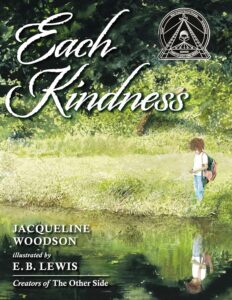
This story is a bit heavier but very important. Maya is a new student who wears ragged clothes.
She tries to befriend Chloe, but Chloe rejects her. Chloe and her friends make fun of Maya behind her back. When Maya eventually moves away, Chloe feels a deep sense of regret. She realizes she missed her chance to be kind.
Unlike many children’s books, this one does not have a tidy ending. It is an honest look at the injustice of exclusion. It forces the reader to sit with the feeling of a missed opportunity.
This can be a much more powerful teacher than a happy resolution. It sparks deep conversation.
What kids notice in this story:
The somber watercolor illustrations usually catch their attention. They often feel a sense of “unfairness” for Maya.
They can identify moments where they have seen someone left out at school.
Story snapshot:
This is a powerful tale about the lasting impact of our choices. It shows how every small act of kindness ripples out like a stone in water.
Why this book helps:
It teaches the “weight” of injustice. It encourages kids to act with kindness in the moment rather than waiting until it is too late.
The Recess Queen — Alexis O’Neill and Laura Huliska-Beith
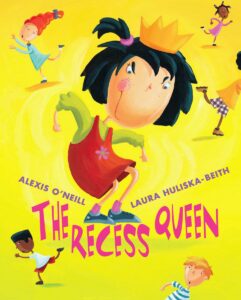
Mean Jean is the “Recess Queen.” She rules the playground with an iron fist. Nobody swings until Mean Jean swings.
That is, until a tiny student named Katie Sue arrives. Katie Sue doesn’t know the “rules.” She simply starts playing. Then, she invites Mean Jean to join her rather than just obeying her.
This book tackles playground politics head-on. It shows how power imbalances make things unfair for everyone.
However, it also shows how one person’s courage can change everything. Katie Sue uses inclusion to dismantle a “regime” of unfairness. It is energetic, funny, and very relatable.
What kids notice in this story:
The wild illustrations make Mean Jean look quite intimidating. However, kids quickly notice how much more fun everyone has once the rules change. They love Katie Sue’s spark.
Story snapshot:
A playground bully meets her match in a new student. By offering friendship instead of fear, Katie Sue turns an unfair environment into a cooperative one.
Why this book helps:
It empowers kids to challenge unfair social hierarchies. It shows that inclusion is a more powerful tool than intimidation.
Practice Fairness With Your Own Story
Reading about fairness is a wonderful start. However, the best way to understand a concept is to live it.
At Scrively, we help kids do exactly that. We make your child the hero of their own personalized story.
Imagine a book where your child decides how to share the slide. They can practice standing up for a new friend in a safe way.
By putting your child in the center of the narrative, they see the impact of their own choices. It is a powerful way to build character and confidence.
Explore how you can create a custom journey for your little leader at Scrively.com.
Navigating fairness and justice is a lifelong lesson. Even adults struggle with it sometimes. But by opening these books, you give your child the right vocabulary.
You build their empathy. This helps them create a world that is a little more just.
Remember that every small act of fairness matters. Keep reading and keep questioning together.