If Your Child Starts Everything but Finishes Nothing, Try These Books
You’ve probably seen the moment before.
A puzzle sits on the table, half finished. A worksheet begins with neat handwriting and slowly dissolves into doodles in the margin. A LEGO tower starts strong but ends abandoned when a new idea appears across the room.
Children between five and eight live in a world full of fascinating distractions. Their curiosity is enormous. Their attention moves quickly. And their brains are still learning how to hold onto one idea long enough to see it through.
So when a child drifts away from a task, it’s rarely about laziness or lack of effort. More often, it’s simply the natural rhythm of a growing mind learning how to focus.
The ability to stay on task develops slowly. It grows through practice, patience, and small experiences of finishing something that once felt difficult.
Picture books offer a surprisingly powerful way to support that growth. Stories allow children to watch characters wrestle with problems, lose focus, start again, and ultimately stick with something long enough to see it through.
In those quiet reading moments, children rehearse persistence. They see what it looks like to try again. And little by little, finishing becomes part of their imagination.
Books That Encourage Focus and Follow-Through
The Magical Yet by Angela DiTerlizzi
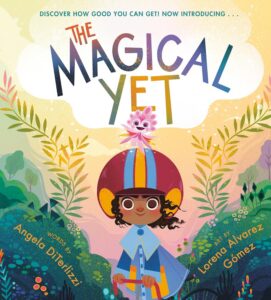
This imaginative story introduces children to the idea of “Yet”—a tiny, magical companion that appears whenever something feels impossible.
Whether learning to ride a bike, finish a drawing, or master a new skill, the word “yet” becomes a reminder that success may simply take more time.
The story gently reframes frustration as a natural step along the road to improvement.
What kids notice in this story
Children begin to see unfinished skills as temporary. The word “yet” helps them imagine continuing instead of quitting.
The Most Magnificent Thing by Ashley Spires

A girl sets out to build something extraordinary. She gathers materials, starts designing, and quickly discovers that making “magnificent” things is harder than it looks.
Her early attempts fail. Pieces don’t fit. Ideas don’t work the way she imagined. Frustration builds as project after project falls short of what she hoped to create.
But instead of abandoning the idea completely, she takes a step back, resets her thinking, and returns with fresh determination. Slowly, piece by piece, her persistence begins to pay off.
What kids notice in this story
Children see that even exciting projects can feel frustrating halfway through. They watch a character pause, rethink, and come back to finish what she started.
Jabari Tries by Gaia Cornwall
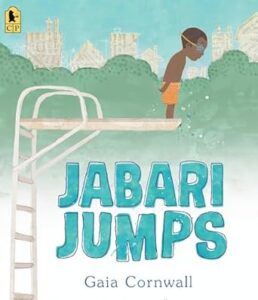
Jabari has a new challenge ahead of him: designing a flying machine. The idea feels exciting at first, but the process quickly becomes complicated.
Each attempt brings a new problem. The design doesn’t work. The wings collapse. The experiment fails again and again.
With the gentle support of his father, Jabari begins to understand that persistence means continuing even when things don’t work the first time—or the second.
What kids notice in this story
Children recognize that trying something new can take multiple attempts. The story shows that sticking with an idea long enough often leads to surprising success.
Flight School by Lita Judge

Little Penguin has a dream—he wants to fly.
The only problem is that penguins aren’t built for flying. Still, Penguin enrolls in flight school anyway, determined to make it work.
Through determination, creativity, and a bit of teamwork, Penguin discovers that persistence sometimes leads to unexpected solutions.
What kids notice in this story
Children watch a character keep pursuing a goal even when others doubt it will work. The story celebrates creative persistence.
A Perfectly Messed-Up Story by Patrick McDonnell
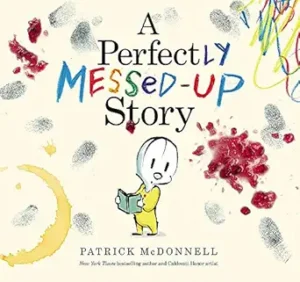
This playful picture book begins like any ordinary story—until a sudden splash of peanut butter interrupts the pages.
Then jelly appears. Soon the story is covered with all kinds of unexpected messes.
The narrator struggles to keep the story moving forward despite the chaos, modeling perseverance in a delightfully silly way.
What kids notice in this story
Kids laugh at the interruptions while recognizing the determination to keep going anyway.
The Pigeon Has to Go to School! by Mo Willems
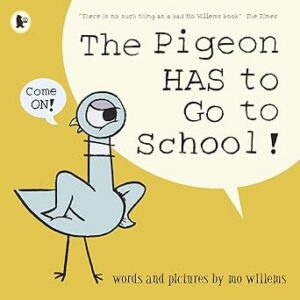
Pigeon is not thrilled about the idea of school. He imagines every possible reason to avoid going.
Through humor and exaggerated worries, the story captures how overwhelming a new experience can feel.
Eventually, Pigeon begins to realize that stepping into something unfamiliar might not be as scary as expected.
What kids notice in this story
Children recognize their own hesitation before new challenges. The story gently nudges them toward following through anyway.
Ada Twist, Scientist by Andrea Beaty

Ada is endlessly curious. Questions follow her everywhere she goes.
When a mysterious smell fills the house, Ada launches into a full scientific investigation. Her experiments create chaos, but her determination never fades.
The story celebrates curiosity while showing the patience required to solve complex problems.
What kids notice in this story
Kids see that big discoveries often come after many attempts and experiments.
The Curious Garden by Peter Brown
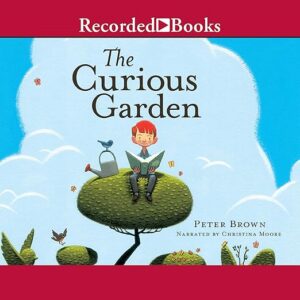
In a gray, industrial city, a boy named Liam discovers a struggling patch of plants growing on an abandoned railway.
Instead of ignoring it, he begins caring for the plants. Slowly, the garden spreads across the city.
Through quiet dedication, Liam transforms his environment one small step at a time.
What kids notice in this story
Children see how small actions repeated over time can create big change.
Focus Grows Slowly
Children rarely learn persistence in a single moment.
More often, it develops through dozens of small experiences: finishing a drawing, completing a puzzle, solving a tricky math problem, or finally building the tower that kept falling down.
Each finished task becomes a quiet signal to the brain: I can do this.
Books help reinforce that signal. When children see characters return to a challenge, try again, and keep working, they begin to imagine themselves doing the same.
Rereading these stories before homework, creative time, or school projects can gently remind children that finishing something—even something small—can feel deeply satisfying.
A Story Where Your Child Finishes the Task
If your child enjoys stories about persistence, you might also enjoy exploring personalized books with Scrively.
Scrively creates stories where your child becomes the main character—working through challenges, finishing projects, and discovering their own ability to keep going.
For many children, seeing themselves inside a story helps reinforce the same message these books offer: focus grows with practice, and persistence is something anyone can learn.
And sometimes the most powerful motivation comes from simply believing, “I can finish this.”