8 Children’s Books About Generosity: The Gift That Cannot Be Wrapped
You know the moment. Your child wants to give someone something special, and their first thought is a toy, a treat, or something with a bow on top. That makes sense. Gifts are easy to see when they come in boxes.
But some of the most important gifts your child will learn to give cannot be wrapped at all. Attention. Time. Comfort. A place beside them. The willingness to share something precious. Generosity becomes deeper when children begin to understand that giving is not only about what leaves their hands. It is also about what comes from their hearts.
That can be a difficult idea to teach directly. Tell a child to “be generous,” and the words may disappear before they reach the toy box. Let them watch a character sit quietly with a hurting friend, give away something treasured, or choose another person over a possession, and the idea becomes a story they can feel.
These children’s books about generosity help you explore that wider meaning of giving. Some involve things that can be held, but the real gift underneath is friendship, presence, empathy, sacrifice, or shared time. They give you a gentle way to ask your child: What can you give when there is nothing to buy?
Children’s Books About Generosity Beyond Presents and Possessions
The eight books below approach generosity from different directions. You will find quiet listening, friendship, family time, community care, and the difficult choice to give up something deeply valued. Read them slowly. The most meaningful conversation may begin with the part your child notices before you say a word.
The Gift of Nothing by Patrick McDonnell
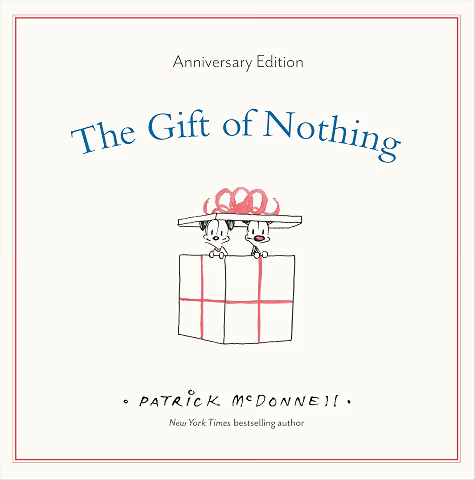
This playful little story begins with a problem many children understand: Mooch wants to give his friend Earl something special, but Earl already seems to have everything he needs. Written and illustrated by Patrick McDonnell, the book turns that familiar gift-giving puzzle into a warm reflection on presence.
Its simplicity is part of its charm. Instead of making generosity bigger and more elaborate, the story keeps stripping things away until friendship itself is what remains.
What kids notice: “Nothing” sounds funny as a present. Children can enjoy the joke before realizing that Mooch is not really giving emptiness. He is giving Earl something much harder to put in a box: himself and their time together.
Story snapshot: Mooch the cat searches for a gift for Earl the dog, who already has the things he needs. After looking for “nothing” in a world crowded with things, Mooch finally finds a way to offer a gift centered on simply being together.
Why this book helps: It gives you an easy opening to ask what makes time with someone feel like a gift. Your child may name playing, listening, cuddling, helping, or sharing a joke. Suddenly generosity has possibilities that do not require money at all.
Saturday by Oge Mora
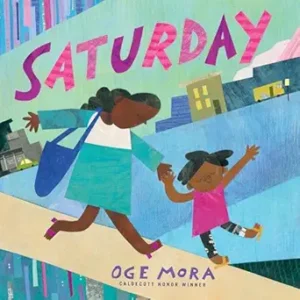
Sometimes the gift is not the outing. It is the person beside you when the outing falls apart. Written and illustrated by Oge Mora, Saturday follows Ava and her mother through a day they have been eagerly anticipating together.
For a child accustomed to measuring a special day by what happens, this story gently shifts the center. Plans matter, but relationship matters more.
What kids notice: One disappointment after another interrupts the perfect Saturday. Children can recognize the frustration of having something exciting go wrong, especially after waiting a long time for it.
Story snapshot: Ava and her mother treasure Saturdays because her mother works the other days of the week. Their plans for storytime, the salon, a picnic, and a puppet show unravel, until Ava reminds her overwhelmed mother that the best part of Saturday is being together.
Why this book helps: You can use the story to separate generosity from spending. Giving your child undivided attention for ten minutes, inviting them into a chore, or taking a walk together can become a real offering. Presence becomes meaningful because it says, “You matter enough for my time.”
The Rabbit Listened by Cori Doerrfeld
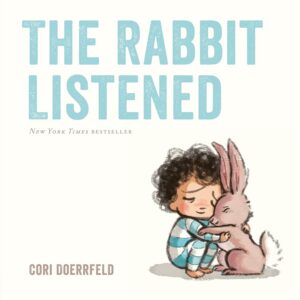
Generosity can look surprisingly quiet. In Cori Doerrfeld’s story, Taylor experiences something upsetting, and a parade of animals arrives with ideas about what Taylor should do next. Their intentions may be good, but none gives Taylor what is actually needed.
Then the rabbit arrives. It does not rush the hurt away. It stays close enough to listen.
What kids notice: The animals respond differently to Taylor’s sadness. One wants to talk, another wants anger, and others bring their own solutions. The rabbit is different because it pays attention before deciding what Taylor needs.
Story snapshot: After Taylor’s block creation is destroyed, several animals offer ways to react. Taylor rejects them. The rabbit quietly stays nearby and listens as Taylor gradually moves through feelings and begins imagining rebuilding.
Why this book helps: This is a beautiful way to show that generosity is not always doing more. Sometimes it is making room for another person. You can practice with your child by asking, “Do you want help, ideas, or someone to listen?” That question itself can be a gift.
A Sick Day for Amos McGee by Philip C. Stead
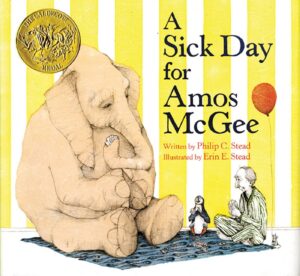
Amos McGee gives his friends a little of himself every day. Philip C. Stead’s gentle story, illustrated by Erin E. Stead, makes those small offerings feel important: a game, quiet company, patience, a story at the end of the day.
Then Amos gets sick, and the direction of care changes.
What kids notice: Amos does not treat every friend exactly the same. He notices what each animal enjoys or needs. That makes his kindness personal rather than automatic.
Story snapshot: Amos works at the zoo and makes time for his animal friends each day. When a cold keeps him home, the elephant, tortoise, penguin, rhinoceros, and owl leave the zoo to visit him and offer the same kind of companionship he has given them.
Why this book helps: It lets you talk about generosity as attention. Ask your child how Amos knows what makes each friend comfortable. Then wonder together what someone in your family might need today. A generous act becomes less about giving “something” and more about noticing someone.
Lubna and Pebble by Wendy Meddour
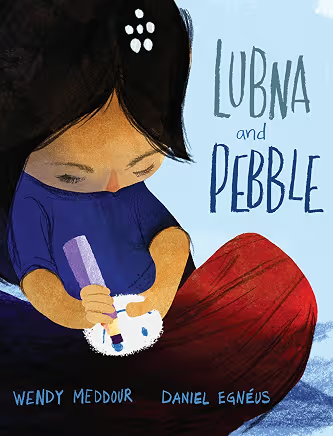
Some acts of generosity cost us something. That truth is handled with extraordinary tenderness in Wendy Meddour’s story, illustrated by Daniel Egnéus. Lubna is a refugee child whose pebble has become a source of comfort in an uncertain world.
Because the pebble matters so much to her, what she eventually chooses carries real emotional weight.
What kids notice: Pebble is ordinary to everyone else, but not to Lubna. She talks to it, cares for it, and draws a face on it. Children understand how an object can become precious because of the comfort attached to it.
Story snapshot: Lubna lives with her father in a “World of Tents” after arriving by sea. When a lonely boy named Amir arrives, they become friends. As Lubna prepares to leave for a new home, she realizes Amir may need the beloved pebble she has relied on.
Why this book helps: It opens a deeper conversation about sacrifice without demanding that your child give away their favorite possession. Ask what made Lubna’s choice generous. The answer is not simply that she gave something away; she understood what it meant to another person.
Those Shoes by Maribeth Boelts
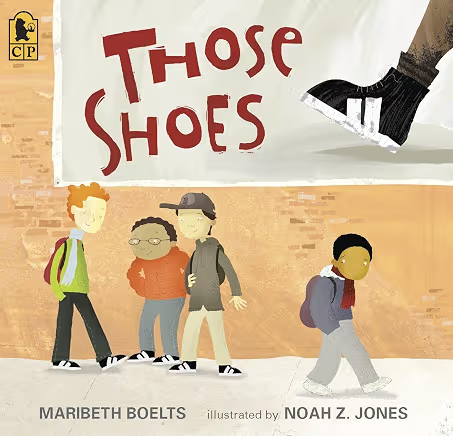
Wanting what everyone else has can feel enormous in childhood. Maribeth Boelts captures that ache through Jeremy, with illustrations by Noah Z. Jones. The story never treats his desire as silly, which makes his later generosity feel earned.
This is giving with a little tension in it—the kind children may recognize in their own lives.
What kids notice: Jeremy really wants the fashionable shoes his classmates wear. He even buys a thrift-store pair that hurts because they are too small. His longing does not magically disappear just because another child could use them.
Story snapshot: Jeremy’s grandmother explains that their budget has room for needs rather than wants. After Jeremy finally finds the coveted shoes secondhand, he realizes they do not fit. He eventually gives them to Antonio, a classmate whose smaller feet can wear them.
Why this book helps: Generosity means more when children see that giving can involve mixed feelings. You can tell your child that it is possible to be generous and still feel a little sad about what you gave. A generous heart does not require pretending the choice was easy.
Thank You, Omu! by Oge Mora

A pot of stew may be something you can touch, but the heart of this story is what happens when one person’s open door changes the feeling of an entire neighborhood. Oge Mora’s lively collage illustrations make generosity feel communal and contagious.
It is especially useful when you want your child to see giving as something that can move in more than one direction.
What kids notice: People keep arriving at Omu’s door, drawn by the delicious smell. Omu keeps sharing until her pot is empty. Then the pattern changes, and the neighbors return carrying gifts of their own.
Story snapshot: Omu cooks a thick red stew and offers portions to neighbors who visit throughout the day. By dinnertime, none remains for her. The community comes back with food and gratitude, turning the evening into a shared celebration.
Why this book helps: You can talk about generosity as creating connection rather than keeping score. Omu’s kindness inspires a response, but she does not give because she has arranged a trade. Ask your child how one generous act can make a room, family, or neighborhood feel different.
Last Stop on Market Street by Matt de la Peña
Generosity can become part of a family rhythm. Written by Matt de la Peña and illustrated by Christian Robinson, this story follows CJ and his Nana across the city while CJ wonders why their life does not look like someone else’s.
Nana does not dismiss his questions. She helps him notice beauty, people, and purpose along the way.
What kids notice: CJ sees things other people have—a car, music players—and wonders why he does not have them. The bus ride gradually widens his attention beyond comparison and toward the people around him.
Story snapshot: After church, CJ and Nana ride a city bus to the last stop on Market Street. Along the way they encounter a range of people and experiences. Their destination is a soup kitchen, where they help serve members of the community.
Why this book helps: It connects generosity with participation. Your child does not need to be the person who owns the most before they can contribute. You can ask, “What could we bring besides money?” Time, effort, conversation, carrying, setting up, welcoming, and noticing all belong on the answer list.
Put Your Child in the Heart of the Story
One reason stories can reach children so deeply is that they let a child rehearse a choice before real life asks them to make it.
They can wonder what they would do with Jeremy’s shoes, how they would comfort Taylor, or what they might offer a lonely child without being put on the spot.
A personalized Scrively story can carry that idea one step closer by placing your child inside an adventure shaped around generosity.
Maybe the meaningful gift is an afternoon spent helping a grandparent. Maybe it is sitting beside a nervous new friend. Maybe your child discovers that the thing another character remembers most was not a present at all, but the moment someone stayed.
Keep the generosity human-sized. The goal is not to cast your child as a perfect hero who gives everything away.
A more believable story lets them notice, hesitate, choose, and discover that what they offer has value. That is often where a virtue begins to feel like their own.
The Gifts Children Remember Are Often the Ones We Cannot Wrap
You do not need to make every act of kindness into a lesson. Generosity grows through repetition: passing the last strawberry, making room on the couch, listening to a long story, helping someone carry something, giving a friend another turn.
You can also let your child receive these invisible gifts. When you stop what you are doing and listen, keep them company after a hard day, or give them your unhurried attention, you are showing them what generosity feels like from the other side.
Over time, your child can discover that having something to give is not the same as having something to buy. They already carry gifts into every room: attention, humor, effort, patience, affection, imagination, and time. Those gifts may never fit beneath wrapping paper. They can still become the ones somebody remembers.