
The Body Bubble: Books to Help Kids Master Physical Autonomy and Consent
You have probably witnessed the exact moment the laughter shifts in the playroom.
Your child is wrestling on the living room rug with a sibling or a close friend. It starts as pure, joyous fun.
The roughhousing is full of giggles, flying cushions, and boundless energy. Then, suddenly, it goes just a little too far. Someone gets squeezed too tight.
A tickle fight becomes completely overwhelming.
The giggles turn into frantic, panicked demands to stop, but the other child does not immediately listen. The invisible line has been crossed, and the playful game has instantly turned into an uncomfortable struggle for physical control.
As a parent, your immediate instinct is to jump in and separate them like a referee. You desperately want to enforce the rules of gentle play and remind everyone to be careful.
However, managing every single physical interaction robs your child of a vital, lifelong developmental milestone.
They must learn how to define and fiercely defend their own physical boundaries. We call this the body bubble.
Physical autonomy is the profound understanding that your child is the ultimate boss of their own physical space.
Furthermore, it is the deeply empathetic realization that they must also respect the invisible bubbles surrounding their friends, siblings, and family members.
Teaching physical autonomy is remarkably complex and requires a nuanced approach.
It requires us to gently push back against generations of ingrained social expectations.
For decades, young children were implicitly taught to hug relatives on demand and tolerate unwanted physical affection simply out of politeness.
Now, we are asking our children to do something incredibly brave and entirely counter-cultural. We are asking them to listen to their own internal comfort levels.
We are empowering them to clearly say “no” when a hug feels overwhelming or when a wrestling match gets too rough. Most importantly, we are teaching them the emotional maturity to stop immediately when a friend asks them to back away.
Fortunately, you do not have to tackle this heavy, intimidating topic with a dry, awkward lecture.
Beautifully crafted children’s books provide the perfect, safe rehearsal space for establishing the body bubble.
Through these engaging, vibrant stories, your child can watch relatable characters navigate the exact same physical dilemmas.
They can borrow the exact words needed to pause a tickle fight, decline a high-five, or ask for more space. Let us explore a fresh, unique collection of stories that will help your child confidently build their body bubble and deeply respect the physical space of everyone around them.
Miles is the Boss of His Body by Samantha Kurtzman-Counter and Abbie Schiller
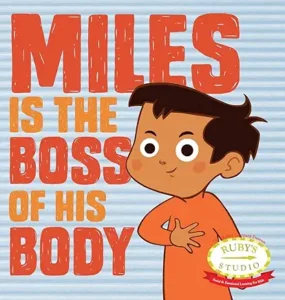
This energetic, highly relatable story tackles the exact dynamic of family gatherings and enthusiastic physical affection.
It is incredibly common for well-meaning adults and older cousins to completely overwhelm a young child with hugs and pinches.
This book addresses that precise overwhelming feeling with brilliant clarity and a deep, refreshing respect for the child’s perspective.
It validates the intense frustration of being tickled, squeezed, and tossed in the air when you simply want to be left alone. The tone is highly empowering, giving children permission to assert their boundaries even with adults they love.
What kids notice: Children immediately notice Miles’s increasingly frustrated, trapped facial expressions as his family members completely ignore his physical boundaries during his birthday party.
Story snapshot: It is Miles’s birthday, and he is incredibly excited to celebrate. However, his entire extended family constantly swoops in to pinch his cheeks, give him massive bear hugs, and tickle him relentlessly.
Miles absolutely hates the physical intrusion, but he feels too small to stop them.
Finally, he reaches his breaking point and loudly declares that he is the boss of his own body, establishing a firm, clear boundary that his family ultimately respects and celebrates.
Why this book helps: When roughhousing or physical affection goes too far, children often freeze in panic.
They do not want to ruin the fun or offend a relative, but they are physically deeply uncomfortable.
This book helps by providing a highly effective, repeatable script. It teaches your child that they have the absolute right to stop any game or interaction that involves their body.
Furthermore, it shows them that using a loud, confident voice to protect their body bubble is not disrespectful.
It is a necessary act of physical autonomy that ensures they feel safe, secure, and respected in their own skin.
Rissy No Kissies by Katey Howes
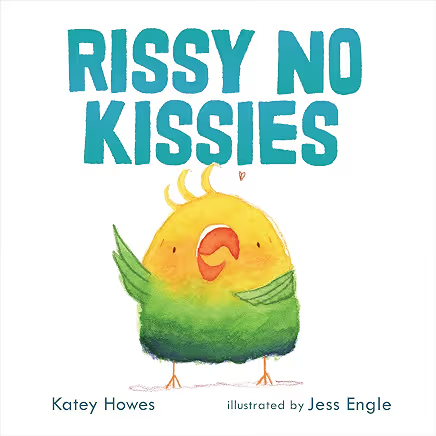
This is a beautifully rhythmic, poetic exploration of sensory boundaries and unconventional affection.
Rissy is a lovebird, a species literally named for their physical affection and constant closeness.
However, Rissy fundamentally dislikes kisses. The illustrations are vibrant, colorful, and incredibly tender, providing a warm backdrop for a serious topic.
The story focuses on the profound realization that love can be expressed in countless ways that do not require physical touch. It is a magnificent, affirming story for neurodivergent children or any child with a heightened sensory awareness.
What kids notice: Kids are fascinated by the fact that a “lovebird” does not like to do the one thing everyone expects lovebirds to do, and they deeply empathize with her feeling of being misunderstood.
Story snapshot: Rissy is surrounded by fellow lovebirds who are constantly sharing kisses and cuddles.
When Rissy politely declines a kiss, the other birds are confused and tell her she is acting wrong.
Rissy begins to feel entirely broken and wonders if she is a bad lovebird.
Fortunately, her wise mother steps in to reassure her that her body and her boundaries are perfectly fine. Rissy learns to proudly express her affection through singing, sharing, and kind words instead of physical touch.
Why this book helps: Society constantly pressures children to accept physical affection as the ultimate proof of love.
This book helps by entirely dismantling that harmful assumption. It teaches your child that they do not owe anyone their physical space, regardless of the social setting.
If your child pulls away from a hug, they often feel a wave of guilt. This beautiful story washes that guilt away.
It helps them understand that holding a firm physical boundary does not make them rude or unloving. It simply makes them the expert on their own unique body bubble.
Harrison P. Spader, Personal Space Invader by Christianne Jones
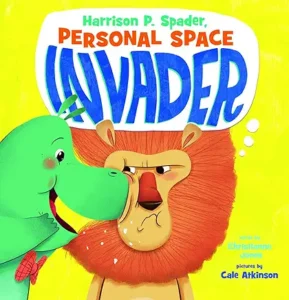
This book brings a massive, necessary dose of humor to the conversation about physical boundaries.
It focuses entirely on the child who struggles to understand the boundaries of others.
Harrison is a well-meaning but incredibly intense hippo who simply cannot keep his physical distance from his friends.
The narrative is sharp, funny, and deeply relatable for parents of highly affectionate, energetic kids. It brilliantly shifts the perspective, showing how uncomfortable it feels when someone else constantly pops your body bubble.
What kids notice: Children laugh out loud at the ridiculous, exaggerated ways Harrison physically crowds his friends on the bus, on the rug, and during a baseball game.
Story snapshot: Harrison P. Spader loves his friends so much that he constantly sits on them, leans against them, and breathes right in their faces.
His complete lack of a body bubble exhausts his classmates, and they eventually start running away from him.
Heartbroken, Harrison talks to his dad, who teaches him the “Space Saver” rule.
Harrison learns to extend his arms to measure a healthy physical distance, allowing him to be a great friend without being an overwhelming space invader.
Why this book helps: Physical autonomy is a two-way street. Your child must learn to protect their own body, but they absolutely must learn to respect the bodies of their peers.
This book helps by providing a hilarious, non-threatening mirror for the child who leans, crashes, and hugs too hard.
It teaches them a highly practical, physical strategy—the arm extension—to measure an appropriate distance.
When a playdate turns into a wrestling match that goes too far, you can reference Harrison P. Spader. It gives your child the perspective they need to back up, check in, and gracefully respect the physical limits of their playmates.
Consent (for Kids!): Boundaries, Respect, and Being in Charge of YOU by Rachel Brian
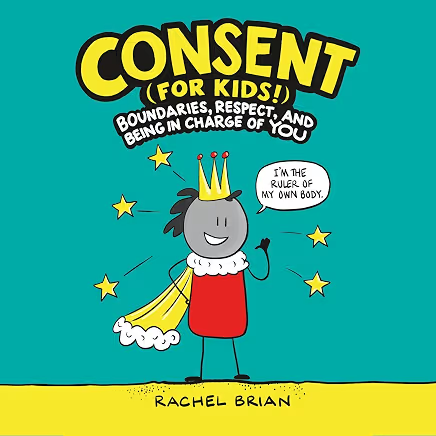
This book takes a graphic novel, comic-style approach to the heavy topic of consent, and the result is an absolute triumph.
It is incredibly witty, fast-paced, and highly engaging for children who are navigating the more complex social dynamics of elementary school.
The humor is sharp and brilliant, completely removing the awkwardness from the subject.
It covers everything from holding hands to changing your mind in the middle of a game. It breaks down the abstract concept of physical consent into bite-sized, hilarious, and highly memorable comic strips.
What kids notice: Kids are instantly drawn to the fun, stick-figure artwork and the hilarious, exaggerated reactions of the characters when boundaries are crossed or respected.
Story snapshot: Through a series of fast-paced, funny vignettes, the book explains exactly what consent means.
It uses relatable analogies, like offering someone pizza, to explain why you cannot force someone to hug you or play a physical game.
It covers the importance of checking in, the absolute right to change your mind, and exactly what to say when your body bubble is being ignored by a peer.
Why this book helps: As children grow older, the playground dynamics become faster and rougher.
This book helps by giving them a modern, cool, and highly accessible vocabulary for physical autonomy.
It teaches your child that consent is not just a rule for adults; it is the foundation of every healthy childhood friendship.
If your child struggles to stop tickling a friend who said “no,” this book visually proves why that behavior is harmful.
It transforms the heavy, academic concept of consent into a practical, everyday tool they can use to navigate the playground with deep empathy and respect.
We Listen to Our Bodies by Lydia Bowers
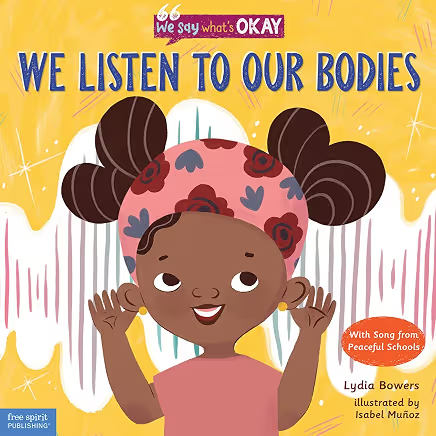
This gentle, highly practical book connects physical autonomy directly to emotional awareness.
It focuses on the subtle, internal physical sensations that occur right before a boundary is crossed. The artwork is diverse, inviting, and wonderfully grounded in a highly realistic preschool classroom setting.
It beautifully bridges the gap between the mind and the body. It teaches children to pay attention to the “uh-oh” feeling in their stomach before a game gets out of hand.
What kids notice: Children notice the relatable classroom environment and the way the characters pause to put a hand on their chest or stomach to figure out how they are feeling.
Story snapshot: Flora is having a busy day at school. Sometimes she feels bouncy and excited, but other times, a game gets too loud or a friend gets too close.
Her teacher helps the class understand that their bodies send them special signals.
Flora learns to recognize her racing heart and tight muscles as a sign that she needs to step back. She practices listening to these internal cues to confidently establish her physical boundaries with her classmates.
Why this book helps: Before a child can defend their body bubble, they must actually recognize that it is being threatened.
This book helps by slowing down the chaotic pace of childhood play. It teaches your child to tune into their own nervous system.
When a wrestling match escalates, your child can remember Flora’s lessons.
They can recognize their own tight chest or panicky feeling as a valid, biological signal to stop the game.
It empowers them to trust their gut instincts and actively advocate for their own physical comfort before a meltdown occurs.
Let’s Talk About Body Boundaries, Consent and Respect by Jayneen Sanders
Jayneen Sanders is a globally recognized expert in children’s safety and body autonomy.
This book is a direct, comprehensive guide that leaves absolutely no room for confusion.
While the tone is highly educational, it remains incredibly warm, empowering, and accessible for young, developing minds.
It tackles the specific, tricky scenarios where children feel pressured to abandon their boundaries. It is an essential, foundational text for any family looking to establish a culture of deep physical respect.
What kids notice: Kids appreciate the clear, straightforward language and the direct questions posed to the reader on every page, inviting them to actively participate in the conversation.
Story snapshot: The book explores various everyday interactions, from playing on the swings to dealing with aggressive peers. It explicitly defines what a body boundary is and explains that no one has the right to cross it without permission. It walks children through exactly how to use a strong, assertive voice to say “Stop” or “I don’t like that,” and reinforces the absolute necessity of respecting those exact words when a friend says them.
Why this book helps: Many children implicitly believe that adults or aggressive peers have the right to dictate their physical space.
This book helps by completely shattering that power dynamic.
It provides a crystal-clear, unambiguous roadmap for physical autonomy. When your child reads this, they receive official, undeniable permission to own their body bubble.
Furthermore, it gives you, the parent, a shared, clinical vocabulary to use during tense playdates.
You can calmly step in and say, “Remember the book? They asked you to stop, so we must respect their body boundary immediately.”
My Body! What I Say Goes! by Jayneen Sanders
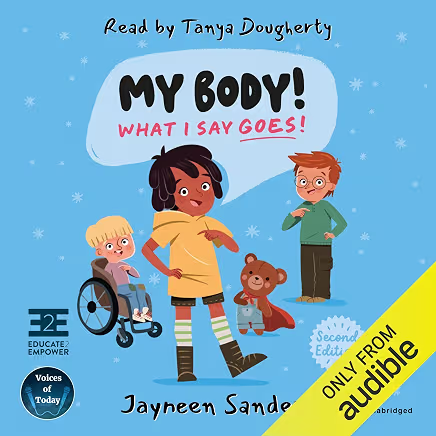
Another absolute masterpiece from Jayneen Sanders, this book focuses intensely on empowering the child to be their own strongest, fiercest advocate.
It covers a wide range of common scenarios, from unwanted family hugs to peer pressure and unsafe touches. The tone is fierce, incredibly confident, and deeply protective.
It builds an impenetrable wall of self-worth around the reader. It is designed to make a child feel ten feet tall and entirely in charge of their own physical universe.
What kids notice: Children are drawn to the confident, superhero-like posture of the main characters. They notice the bold, uncompromising language used to establish safety rules.
Story snapshot: A confident narrator guides the reader through the absolute rules of body ownership.
The book emphasizes that a child’s body belongs to them, from the top of their head to the tips of their toes.
It explores the concept of safe and unsafe touches, the importance of a trusted adult network, and the immense power of the word “No!” when anyone tries to make them physically uncomfortable.
Why this book helps: Self-advocacy in the physical realm requires a massive amount of bravery.
This book helps by acting as a suit of armor for your child’s self-esteem. It teaches them that their voice is an incredibly powerful tool for protection.
When a roughhousing game turns scary or a friend refuses to stop tickling them, your child needs to know they have the moral authority to end the interaction.
This story builds that exact authority. It permanently anchors the idea that what they say about their body goes, without exception.
C is for Consent by Eleanor Morrison
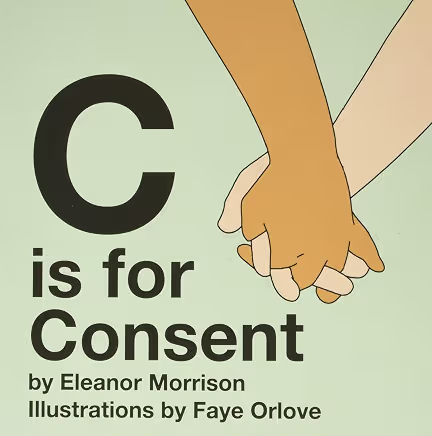
This is a foundational, beautifully simple board book that normalizes bodily autonomy for the very young.
It focuses heavily on the concept of greeting family members and friends without the stressful obligation of physical touch.
The illustrations are diverse, sweet, and perfectly capture the everyday flow of family gatherings.
It completely removes the stigma of declining a hug. It is the perfect, gentle introduction to physical autonomy for toddlers and preschoolers who are just beginning to navigate social expectations.
What kids notice: Toddlers love the clear, bright illustrations of families arriving for a party, and they easily recognize the alternative greetings like high-fives and fist bumps.
Story snapshot: A young boy named Finn is attending a family gathering. As various relatives arrive, Finn is given the explicit choice of how to greet them.
He chooses to hug his grandparents, but politely declines a hug from his aunt, opting for a high-five instead.
The family completely respects his choices, celebrating his autonomy and ensuring he feels entirely safe and loved without forced affection.
Why this book helps: You cannot start teaching physical autonomy too early. This book helps by intercepting the people-pleasing instinct before it ever takes root.
It shows your child that their body bubble is respected right from the start. By seeing Finn happily navigate a party without being forced to cuddle, your child learns that they do not need to feel guilty for physical boundaries.
It builds a foundational layer of profound self-respect that will serve them well into their older, more complex school years.
Put Your Child in the Heart of the Story
Books are truly incredible teachers for growing minds.
However, reading a beautiful, empowering story with your own name printed on the pages is pure, undeniable magic.
Therefore, Scrively helps you create 100% custom children’s books easily and beautifully.
You can seamlessly build a vibrant story where your child is the brave protagonist learning to protect their body bubble.
For instance, they can practice setting physical boundaries, navigating a roughhousing limit, and finding their assertive voice right on the printed page.
Ultimately, this places them at the very heart of their own emotional growth, allowing them to mentally rehearse the virtue of physical autonomy before they ever face an overwhelming playdate.
Navigating the complex physical dynamics of childhood play is a massive developmental hurdle.
You will inevitably face difficult moments when a wrestling match turns to tears or a well-meaning relative feels slighted by a refused hug.
However, every single one of those awkward, tense moments is a profound chance to help your child find their physical footing.
By reading these carefully curated stories, you give your child the precise words and visual anchors they desperately need.
Most importantly, you teach them that true friendship and family love require a deep, unwavering respect for personal space.
Finally, they will learn to navigate the world with a profound, unshakeable confidence, knowing that their body bubble belongs entirely to them.