Helping Your Child Find Their Voice: Books That Teach the Courage to Be an Upstander
You have probably seen it happen.
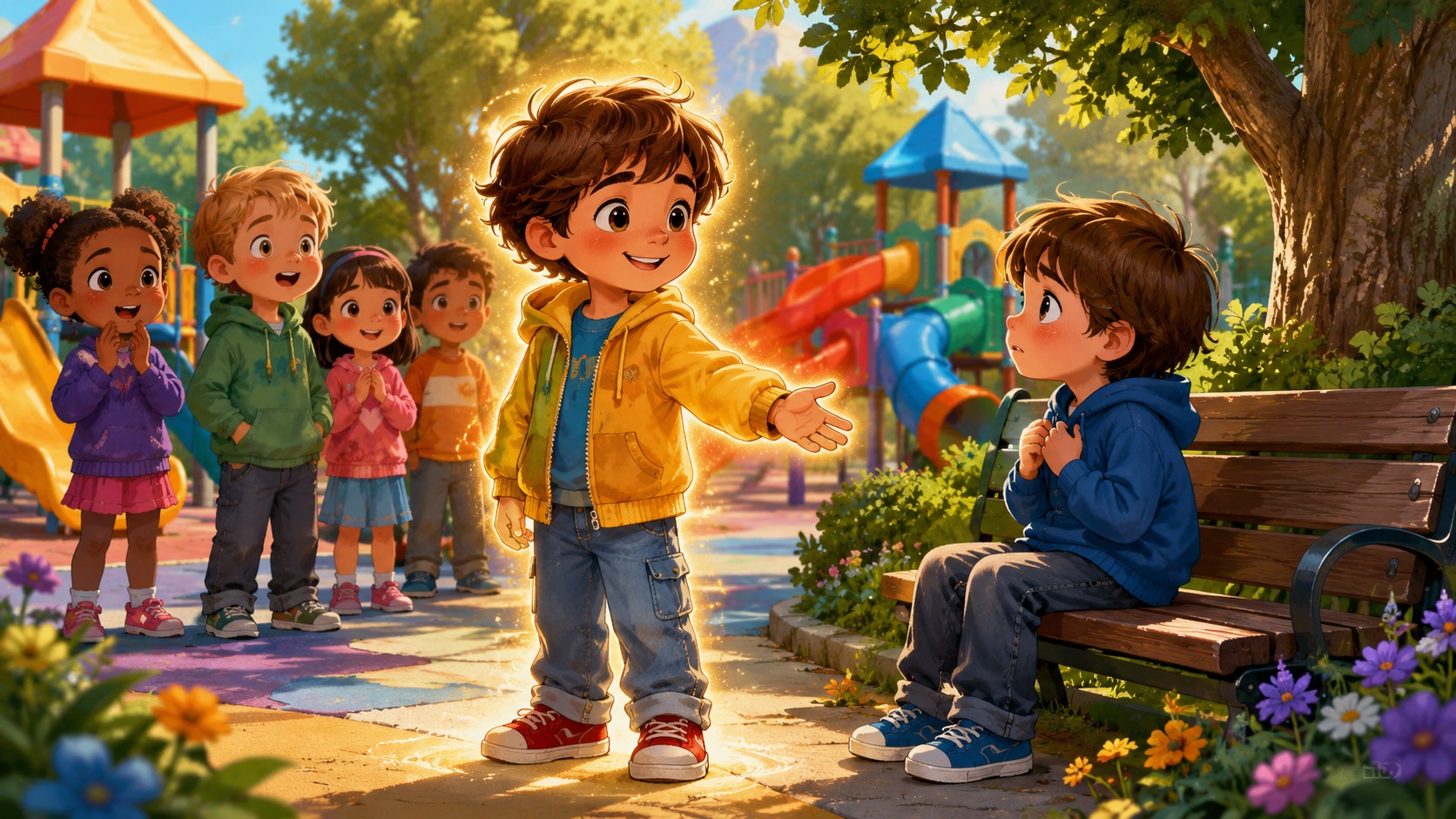
You are at the playground, or the park, or volunteering in the classroom. You notice another child being left out of a game.
Furthermore, you might hear a harsh whisper or a mean-spirited joke directed at a quiet kid.
Then, you look at your own child. You can see the gears turning in their head. They know something is wrong. They feel that heavy, uncomfortable knot in their stomach.
However, they freeze.
They look down at their shoes. Consequently, the moment passes without a word spoken.
As a parent, your heart aches in that exact second. You know your child is kind. You know they understand fairness.
Most importantly, you know they want to help. But finding the voice to intervene and stand up when someone else is being treated unfairly is incredibly difficult.
It takes a massive amount of courage to break away from the crowd.
This is the journey of becoming an upstander. It is the shift from feeling empathy internally to taking action externally.
Moreover, it is a skill that takes years to develop. Children naturally fear drawing attention to themselves.
They worry about becoming the next target. Therefore, our job is not to shame them for their hesitation, but to give them the tools and the language they need for the next time.
Stories are the perfect practice ground for this virtue of justice.
When children read about characters finding their voice, they safely experience the fear and the eventual triumph of doing the right thing.
Beautifully, they learn that being an upstander does not always mean shouting.
Sometimes, it just means walking over and sitting next to the kid who is alone. Here are the best books to help your child build that brave, beautiful muscle.
Say Something! by Peter H. Reynolds
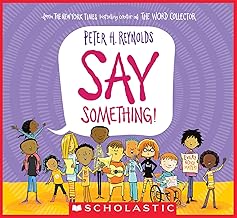
This vibrant, empowering book completely redefines what it means to use your voice. It removes the pressure of needing a loud, booming personality to make a difference.
Furthermore, Peter H. Reynolds masterfully shows kids that their voice is uniquely theirs.
Whether it is through words, art, or quiet actions, every child has the capacity to shift the energy in a room. Consequently, it is a brilliant starting point for children who feel they are too shy to stand up to unfairness.
What kids notice: Children instantly connect with the colorful, expressive speech bubbles.
They notice how different characters use different methods to express themselves, realizing that painting a picture or planting a garden can be just as powerful as speaking into a microphone.
Story snapshot: The narrative follows various children as they discover the world around them and realize they have something valuable to contribute.
From speaking up against an injustice to comforting a lonely peer, the book outlines the myriad ways a single person can spark positive change simply by choosing not to stay silent.
Why this book helps: Above all, this book helps because it democratizes courage.
It explicitly teaches the virtue of justice by showing that standing up for someone else does not require you to be the most extroverted kid in the class.
For instance, it validates the quiet child who chooses to hold a friend’s hand rather than confront a bully directly.
It broadens their understanding of what an “upstander” looks like, making the concept feel achievable and deeply personal.
One by Kathryn Otoshi

This is a brilliant, abstract masterpiece that uses colors and numbers to teach a massive lesson about boundaries, bullying, and the power of a single voice.
It strips away the complicated social baggage of human characters.
Instead, it relies on pure, striking visual metaphors. Red is a hothead. Blue is quiet.
The dynamic is immediately recognizable to any child who has ever been on a playground. It is a deceptively simple story with a thunderous impact.
What kids notice: The bold, minimalist watercolor splatters are incredibly captivating. Children notice how Blue literally shrinks and changes shape when Red picks on him.
Furthermore, they love the exact moment when the character “1” stands tall and rigid, completely unbothered by Red’s bluster.
Story snapshot: Blue is a peaceful color, but Red is a hothead who constantly picks on Blue.
Sadly, the other colors are too afraid to say anything, which only makes Red grow bigger and meaner.
Everything changes when the number “1” arrives. One stands up straight, looks Red in the eye, and simply says, “No.” Slowly, the other colors realize they can stand up and count, too.
Why this book helps: This book helps because it perfectly models the exact language of an upstander. It shows that intervening does not require a long, complicated argument.
Sometimes, a firm, unwavering boundary is enough. By watching the other colors transform into numbers and join “1,” children learn that courage is deeply contagious.
When one person finds the voice to stand up against unfairness, it gives the rest of the crowd the bravery to follow.
I Walk with Vanessa by Kerascoët
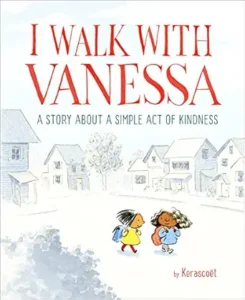
This wordless picture book is an absolute treasure for sparking conversations about justice and empathy.
Because there is no text, you and your child get to narrate the feelings, the hesitations, and the eventual bravery of the characters yourselves.
It is inspired by real events and captures the heavy, lingering pain of witnessing someone being treated poorly.
More importantly, it highlights the brilliant, uplifting joy of communal support. It is a visual masterclass in solidarity.
What kids notice: Without words to guide them, children hyper-focus on the facial expressions and body language of the characters.
They notice the exact moment the main character witnesses the bullying, and they see how heavily that memory weighs on her throughout the evening.
Story snapshot: A new girl, Vanessa, is verbally bullied by a classmate on her way home from school. Another girl sees this happen but initially does nothing. That night, she is visibly upset and conflicted about her inaction.
The next morning, she makes a brave choice: she walks to Vanessa’s house and offers to walk to school with her. Soon, another child joins them, and then another, until a massive crowd is walking in solidarity with Vanessa.
Why this book helps: This story helps because it validates the very real hesitation kids feel in the moment. It shows that it is okay if you freeze the first time. You can always make a better choice the next day.
By focusing on the act of walking alongside someone, it teaches kids that intervening doesn’t have to mean engaging with the bully. Supporting the victim is a powerful, profound act of justice.
The Juice Box Bully by Bob Sornson and Maria Dismondy
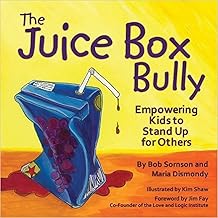
If you are looking for a highly practical, classroom-based scenario, this book is an essential read.
It tackles the reality that kids often encounter challenging behavior from peers who might be struggling internally.
It does not paint the “bully” as an unredeemable villain. Instead, it focuses on the culture of the classroom. It brilliantly explores what happens when a group of kids actively decide they will not tolerate mean behavior, creating a safety net for everyone.
What kids notice: Children notice the collective power of the classroom.
They are fascinated by “The Promise” the students have made to each other. Furthermore, they notice that the kids do not return Pete’s mean behavior with more meanness; they hold their ground with firm kindness.
Story snapshot: Pete is the new kid at school, and he starts acting out immediately—stealing, name-calling, and squirting juice on other kids.
But this classroom has a rule: they promise to be upstanders. Instead of fighting back or shrinking away, the kids remind Pete of their classroom promise.
They refuse to be bystanders, eventually teaching Pete that he doesn’t have to be mean to fit in.
Why this book helps: This book helps because it provides a clear, actionable blueprint for group accountability. It teaches children that justice is a community effort.
When someone is treated unfairly, relying on a shared standard of respect makes it easier to find the voice to intervene.
It shifts the burden of courage from one single child to the entire peer group, demonstrating the incredible power of a positive peer culture.
Stick and Stone by Beth Ferry, illustrated by Tom Lichtenheld
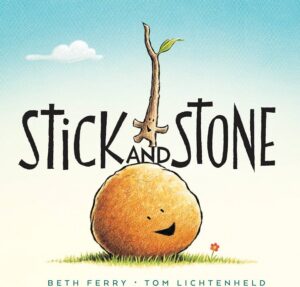
For younger readers, complex social dynamics need to be simplified into lovable, accessible characters.
Beth Ferry achieves this flawlessly with a stick and a stone. The rhyming text is bouncy and rhythmic, keeping toddlers and preschoolers engaged.
However, beneath the playful illustrations is a very real lesson about loyalty and speaking up. It is the perfect introduction to the concept of standing by a friend when things get tough, planting the seeds of an upstander early on.
What kids notice: Kids love the funny, expressive faces on the inanimate objects. They specifically notice the prickly, bullying nature of Pinecone, and they cheer when Stick steps in to defend his round, quiet friend.
Story snapshot: Stick and Stone are both lonely until they meet and form a fast friendship. Their bond is quickly tested when Pinecone makes fun of Stone.
Without hesitation, Stick steps up and tells Pinecone to “vanish,” fiercely defending his new buddy. Later, when Stick is in trouble in a puddle, Stone rolls to the rescue, proving that friendship and upstanding go both ways.
Why this book helps: This story helps because it boils the virtue of justice down to its purest essence: friends protect friends.
It shows young children that finding the voice to intervene is a natural extension of caring about someone else.
It provides a simple, memorable script (“Vanish!”) that kids can conceptualize when they see someone being picked on, proving that small heroes can make a big difference.
Each Kindness by Jacqueline Woodson, illustrated by E.B. Lewis
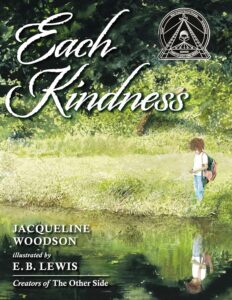
This is, without a doubt, one of the most powerful and beautifully heartbreaking books in modern children’s literature.
Unlike most picture books, it does not tie everything up in a neat, happy bow. It is relentlessly honest about the sting of missed opportunities.
Jacqueline Woodson delivers a lyrical, sobering narrative about the reality of exclusion. It is meant for slightly older children who are ready to grapple with the emotional weight of regret and the importance of acting when you have the chance.
What kids notice: Children immediately notice the palpable sadness in the illustrations. They recognize the realistic playground dynamics—the whispered secrets, the intentional turning away.
Most importantly, they notice the heavy, unresolved ending, which often prompts deep, thoughtful questions.
Story snapshot: Maya is a new student who wears ragged clothes and desperately tries to make friends.
Chloe, the narrator, repeatedly rejects her and looks the other way when others mock Maya.
One day, Maya moves away. Chloe’s teacher gives a lesson on how every kindness ripples out like a stone dropped in water.
Chloe is left staring at quiet water, devastated by the realization that she missed her chance to be kind, and the opportunity is gone forever.
Why this book helps: This book helps because it deals with the reality of being a bystander. It teaches the virtue of justice by showing the profound cost of doing nothing when someone is treated unfairly.
By allowing the protagonist to experience real regret, it highly motivates readers to choose a different path. It urges children not to wait for the “next time” to be an upstander, because next time is never guaranteed.
Speak Up by Miranda Paul, illustrated by Ebony Glenn
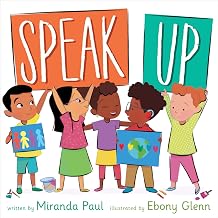
This is a joyful, energetic celebration of everyday activism and using your voice.
It moves the concept of being an upstander beyond just bullying, showing how kids can stand up for their community, the environment, and each other.
The rhythmic, rhyming text makes it a fantastic read-aloud. It frames speaking up as a positive, proactive choice rather than just a defensive reaction. It is a bright, empowering anthem for modern kids.
What kids notice: Kids are drawn to the diverse, bustling cast of characters taking action in various settings. They notice the practical examples: thanking a teacher, admitting a mistake, or making a sign to change a rule.
Story snapshot: The book follows a diverse group of elementary schoolers through their day. It shows them encountering small, everyday moments that require a voice.
Whether it is telling a friend that their shoe is untied, apologizing for an accident, or organizing a peaceful protest to protect a local park, the children learn that their voices have immense power to shape their world.
Why this book helps: This book helps because itNormalizes the act of speaking up. It expands the definition of an upstander, showing that finding the voice to intervene applies to both big injustices and tiny daily moments.
It empowers children to see themselves as active, capable participants in their communities, building the foundational confidence required to stand up for what is right.
Put Your Child in the Heart of the Story
Sometimes, the best way for a child to learn how to be an upstander is to see themselves actually doing it.
With Scrively, you can create 100% custom kid’s books that place your child directly in the center of the narrative.
Imagine a beautifully illustrated story where your child is the hero who finds their voice and stands up for a friend.
By personalizing the challenges and the triumphs, you can safely guide them through the complex emotions of stepping out of the crowd.
It is point-and-click simple, allowing you to craft a powerful tool for emotional development in just minutes.
Finding the courage to be an upstander is a lifelong practice.
It is completely normal for children to stumble, hesitate, and sometimes stay quiet when they wish they hadn’t.
Give them grace. Keep reading these stories, keep talking about what it means to be brave, and celebrate the small moments when they choose kindness over comfort.
Over time, that quiet empathy will absolutely transform into a strong, confident voice.