
The Magic Mirror: Books That Teach Digital Ethics to Kids
You see it.
That familiar blue glow illuminating their small face.
The quiet trance that falls over them when a screen turns on.
It is a magic mirror, pulling them into a world of endless movement, bright colors, and infinite stories. It is undeniably captivating.
And honestly, for a parent, it can be a little terrifying.
Because you know that this screen is just the beginning.
The digital world is vast, wild, and incredibly permanent. You know that eventually, they will hold their own devices.
They will navigate comment sections, text threads, and shared photos. They will have to make rapid-fire decisions about kindness, safety, and truth in spaces where you cannot always hold their hand.
Our instinct is often to build a fortress.
To delay the screens. To set the timers. To strictly manage the minutes and the apps. And that is a worthy, necessary effort.
But creating boundaries is only half the work. The other half is preparation. We have to prepare our kids for the digital world before they even have their own screen.
We need to give them a moral compass that functions just as well online as it does on the playground.
How do we do that? We do it the way we teach them everything else that matters.
We use stories. We use the safe, familiar space of a picture book to explore the complicated, invisible rules of digital ethics.
By sitting together with a physical book, turning real paper pages, we can begin the most important conversations they will ever have about their digital lives.
The Technology Tail by Julia Cook
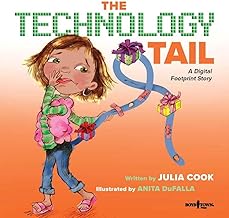
This book tackles one of the hardest concepts for young minds to grasp: permanence.
The internet feels like a disappearing act to a child. You type something, you click a button, and it vanishes into the ether. Julia Cook brilliantly gives physical form to this invisible reality.
It is a clever, visually engaging story that makes the abstract concept of a digital footprint incredibly concrete.
The illustrations are vivid, drawing children into a world where their choices leave a literal, visible mark that they must drag behind them wherever they go.
What kids notice: Children immediately lock onto the physical tail growing behind the main character.
They love seeing how different actions make the tail change colors, grow heavier, or become lighter, treating the tail almost like a separate character in the story.
Story snapshot: The story follows a young boy who loves screens but doesn’t always think before he clicks, types, or posts.
Every time he is unkind online, his “technology tail” grows longer, heavier, and darker. When he is kind and responsible, the tail lightens. He soon realizes that his digital tail follows him into the real world, affecting his real-life friendships and opportunities.
Why this book helps: Children are tactile learners. They understand what they can see and touch. The concept of a digital footprint is notoriously difficult to teach because it lacks physical presence.
This book bridges that cognitive gap perfectly.
By giving the child a heavy, cumbersome tail that results from poor online choices, it anchors the idea of digital consequences in a physical reality they can comprehend.
It helps them understand that the screen is not a shield, and that the words they type have real weight. You can use this story to establish a shared family vocabulary.
When your child is eventually navigating text messages or online games, you can gently ask them, “Is this going to make your technology tail heavier, or lighter?” It removes the lecture and replaces it with a shared, understood concept.
Tek: The Modern Cave Boy by Patrick McDonnell
Patrick McDonnell brings his signature warmth and wit to a story that feels ancient and incredibly urgent all at once.
This book is a delightful juxtaposition of prehistoric life and modern digital obsession. It is designed to look like a thick electronic tablet, instantly grabbing a tech-savvy child’s attention before they even open the cover.
The brilliance of this book lies in its humor. It doesn’t preach. It doesn’t scold. It just gently pokes fun at how silly we all look when we forget to look up at the world around us.
What kids notice: Kids are fascinated by the book’s physical design. They notice that the cover looks like an iPad, complete with battery icons and signal bars.
They also find it hilarious that a dinosaur-era cave boy has a cell phone and video games.
Story snapshot: Tek is a cave boy who refuses to leave his cave. Why? Because his cave has Wi-Fi, tablets, and video games.
While his friends are outside inventing the wheel and discovering fire, Tek is glued to his screens. It takes a massive, ground-shaking intervention from a friendly dinosaur to finally disconnect Tek and show him the beauty of the real, sunlit world.
Why this book helps: Digital ethics isn’t just about how we treat others online; it is also about how we manage our own attention.
This book addresses the virtue of digital balance. Children get locked into the dopamine loop of screens very easily.
They lose track of time, space, and their physical bodies. This story validates the pull of the screen while gently reminding them that the grandest, most exciting adventures still happen offline.
It helps parents introduce the concept of “unplugging” without framing it as a punishment. Instead, unplugging is framed as an invitation.
It shows children that stepping away from the device is the only way to truly experience the warmth of the sun, the thrill of physical play, and the joy of face-to-face connection.
Unplugged by Steve Antony
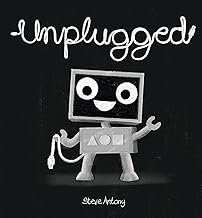
Steve Antony delivers a visually striking, beautifully simple story about a little robot who loves his digital life just a bit too much.
The artwork uses stark, contrasting colors to show the difference between the mesmerizing pull of the screen and the vibrant, chaotic beauty of nature.
It is a gentle, rhythmic read that feels like a quiet sigh of relief. It moves at a pace that deliberately slows down as the main character discovers the world outside.
What kids notice: Children immediately spot the transition in the artwork. They notice how the story starts inside, focused entirely on a glowing screen, and then explodes into a wide, colorful world once the robot physically unplugs.
Story snapshot: Blip is a little robot who spends all day plugged into her computer, playing games and learning facts.
She loves her digital world. But one day, a physical accident causes her to become literally unplugged. She tumbles all the way downstairs and out the front door.
Suddenly, she is in the real world. She discovers rolling hills, real animals, and the physical sensation of playing until the sun goes down.
Why this book helps: This story perfectly captures the anxiety and subsequent joy of disconnection. Many children feel a genuine sense of panic when screen time ends.
This book normalizes that transition. It shows that while the digital world is fun and educational, the physical world offers sensory experiences that a screen simply cannot replicate.
It teaches children the ethical responsibility they have to their own physical well-being. It encourages them to value the texture of the grass, the sound of the wind, and the physical exertion of real-world play.
When your child struggles to transition away from a tablet, you can remind them of Blip. You can talk about what “real world” adventures you might find once you bravely choose to unplug.
Chicken Clicking by Jeanne Willis
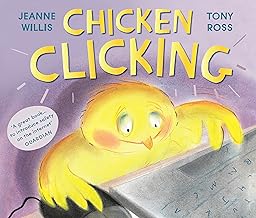
This is a modern cautionary tale wrapped in a delightfully quirky farmyard setting.
Jeanne Willis tackles the very real, very scary topic of internet safety and online predators with a light enough touch that it remains appropriate for young readers, but a firm enough message that it leaves a lasting impression.
The rhyming text bounces along cheerfully, masking the slow build of the underlying danger, making the final realization all the more impactful for the reader.
What kids notice: Kids love the silly premise of a little chick using a farmer’s computer to buy ridiculous things online. They laugh at the diamond watches and motorbikes being delivered to a barn.
Story snapshot: A little chick sneaks into the farmer’s house at night and starts using his computer. First, she buys silly gifts for her farmyard friends. But then, she ventures into online chat rooms.
She meets a “friend” who has a profile picture of a cute, fluffy chick. They arrange to meet in the physical world in the dark woods. But when she arrives, the friend is not a fluffy chick at all. It is a hungry fox.
Why this book helps: This is an essential conversation starter about online anonymity.
Children are naturally trusting. If an avatar looks like a friendly puppy, they assume the person behind it is friendly, too. This book introduces the concept of digital deception in a way that is easily understood.
It teaches the vital ethical rule: you never really know who is behind the screen.
It allows parents to establish firm rules about never sharing personal information, never sending pictures, and never agreeing to meet an online friend. It brings the age-old “stranger danger” conversation into the twenty-first century, ensuring your child understands that digital strangers require the exact same caution as physical ones.
Webster’s Email by Hannah Whaley

Hannah Whaley breaks down the mechanics of digital communication into a format that even preschoolers can grasp.
This is a bright, cheerful book that tackles the speed and uncontrollability of hitting the “send” button.
It acts as a visual map of the internet, showing how one tiny action multiplies and spreads faster than anyone could possibly chase it down.
What kids notice: Children are fascinated by the counting aspect of the book. They notice the numbers growing rapidly as one email turns into two, then four, then a whole screen full of messages flying around the globe.
Story snapshot: Webster is a little spider who decides to send a funny picture of himself in an email.
He clicks send, but immediately regrets it. He tries to catch the email, but it is too late.
The story follows the email as it bounces from screen to screen, being forwarded by his friends to their friends, multiplying exponentially until everyone in the world has seen Webster’s silly picture.
Why this book helps: This story perfectly illustrates the concept of digital virality and loss of control.
Children often act on impulse. They think something is funny in the moment and want to share it.
This book teaches the crucial pause. It teaches the ethical responsibility of thinking before you click.
Once something is out there, you cannot get it back. It helps children understand that sharing information online is like squeezing toothpaste out of a tube; it is impossible to put it all back in.
By reading this story, you are giving your child a mental speed bump. You are helping them develop the habit of taking one deep breath and asking, “Am I okay with everyone seeing this?” before they ever hit the send button.
The Fabulous Friend Machine by Nick Bland
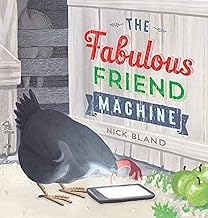
Nick Bland delivers a masterclass in storytelling with this vibrant, incredibly clever fable about the true meaning of friendship in a hyper-connected world.
The illustrations are lively and expressive, capturing the charm of the farmyard and the creeping isolation of screen addiction.
It is a gentle critique of social media and the hollow nature of digital popularity, wrapped up in a story about a very friendly chicken.
What kids notice: Kids notice how Popcorn the chicken changes. They see her go from a happy, social animal who says hello to everyone, to a hunched-over bird who only stares at her glowing screen, ignoring all her real friends.
Story snapshot: Popcorn is the friendliest chicken on the farm. She spends her days chatting with everyone.
But one day, she finds a glowing rectangle in the barn. It is a “fabulous friend machine” (a smartphone).
Soon, Popcorn is obsessed. She is making hundreds of digital friends and ignoring her real ones.
But when she invites her digital friends to a real-world party, she discovers they aren’t friendly at all—they are a pack of hungry wolves. Thankfully, her ignored real-world friends step in to save her.
Why this book helps: This is a beautiful exploration of the difference between connection and attention.
The internet offers children the illusion of massive popularity. It is easy to confuse “likes” and “followers” with actual friendship.
This book teaches the digital virtue of prioritizing deep, authentic relationships over broad, shallow digital approval.
It shows kids that real friends are the ones who show up for you, who protect you, and who know you in the real world. It helps parents frame a conversation about why we use devices.
Are we using them to actually connect with people we love, or are we just seeking the fleeting dopamine hit of a notification? It grounds a child’s understanding of friendship firmly in reality.
Dot. by Randi Zuckerberg
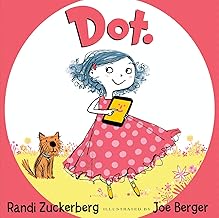
Randi Zuckerberg offers an empowering, energetic look at a child who loves technology but learns how to integrate it healthily into her whole life.
Dot is a vibrant, relatable protagonist who isn’t told that technology is bad, but rather that it is just one tool in a very big toolbox.
The text is punchy and fun, reflecting the high energy of a curious child who wants to do everything all at once.
What kids notice: Children love Dot’s enthusiasm. They notice all the different ways she uses her tablet—to paint, to learn, to play games.
But they also notice how much fun she has when she brings those same activities into the muddy, messy real world.
Story snapshot: Dot is a tech-savvy little girl. She knows how to tap, swipe, and share. She uses her devices for everything.
But one day, she decides to take her digital skills outside. She realizes that while she can paint on a screen, painting with real, messy paint is even better.
She realizes that while she can share a photo of a bug, catching a real bug with her friends is far more exciting. She learns to use her tech as a starting point, not the finish line.
Why this book helps: This book champions the virtue of digital agency. We do not want our children to be afraid of technology; we want them to be masters of it.
We want them to use it actively, not consume it passively. This story helps reframe the screen from a babysitter to a creative tool.
It shows children that the best way to interact with the digital world is to let it inspire your physical world. It helps parents encourage their kids to take what they learn online and apply it offline.
It teaches children that they are in charge of the device; the device is not in charge of them. This is the ultimate goal of digital ethics: creating confident, balanced, and intentional users of technology.
Put Your Child in the Heart of the Story.
While these books are incredible tools for starting conversations about the digital world, there is nothing quite as powerful as seeing yourself in the narrative. That is where Scrively comes in.
With Scrively, you can create fully customized children’s books where your child is the main character.
You can craft stories that specifically address the challenges they are facing—whether it is learning to put the tablet down, understanding how to be kind in a digital space, or finding the courage to speak up.
By placing your child directly into the adventure, you make the lessons stick. You turn abstract virtues into personal triumphs. Point, click, and create a roadmap for your child’s emotional growth today.
The digital world isn’t going away.
It will only grow more complex, more immersive, and more demanding of our children’s attention. But you are not powerless.
You do not have to wait until they are holding a smartphone to start shaping their digital character.
By opening these picture books, by sitting close and reading together, you are planting deep roots.
You are giving them the empathy, the restraint, and the critical thinking they will need to navigate the magic mirror safely. You are teaching them how to be good humans, no matter what screen they happen to be looking at.