Best Books for Kids Who Struggle With Sharing (Ages 4–7)
You probably already know this, even if no one ever said it out loud: sharing is hard.
Not “please-try-harder” hard. Not “we’ve explained this a hundred times” hard.
But genuinely, developmentally hard—especially for kids between four and seven who are still figuring out where they end and the rest of the world begins.
At this age, ownership often equals safety. That toy isn’t just a toy. It’s familiar. It’s predictable.
It’s something your child can count on in a world that still feels very big and very loud. When someone reaches for it, the reaction isn’t selfishness. It’s protection.
That’s why asking kids to share on demand can feel overwhelming. It asks them to give up control before they’ve built enough internal security to feel okay doing so.
And when adults rush the moment, kids don’t learn generosity—they learn to brace themselves.
Stories slow everything down.
They let children watch characters struggle, hesitate, protect, and eventually connect—without being the one in the spotlight.
A good book gives kids space to explore sharing emotionally before they’re expected to practice it socially.
The books below don’t force lessons or demand tidy behavior.
They meet kids where they are—protective, unsure, curious—and gently show what happens when trust builds at its own pace.

Should I Share My Ice Cream? — Mo Willems
What kids notice in this story:
You can almost feel the internal tug-of-war. Kids notice Gerald’s hesitation, his excitement, his doubt, and the way time keeps moving while he decides.
The tension feels familiar—and a little funny—because it mirrors how hard choices actually feel.
Story Snapshot:
Gerald the Elephant gets ice cream and immediately faces a dilemma: should he share it with his friend Piggie, or keep it all for himself?
As he debates, circumstances quietly change.
Why this book helps kids who struggle with sharing:
The story validates hesitation instead of rushing past it.
Kids see that wanting something for yourself doesn’t make you bad—it makes you human.
Sharing becomes something to consider, not something demanded, which helps children feel safer exploring generosity on their own terms.
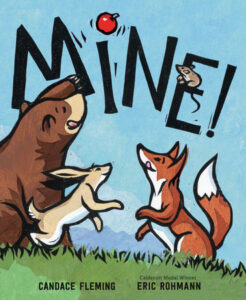
Mine! — Candace Fleming
What kids notice in this story:
Kids notice the escalating tension and the way “mine” starts to isolate everyone involved.
They also notice how the emotional temperature changes when the characters finally pause and regroup.
Story Snapshot:
A group of animals discovers a shiny object and immediately claims it as their own. The struggle intensifies until the object—and the moment—slips away.
Why this book helps kids who struggle with sharing:
This story doesn’t scold possessiveness.
It shows its consequences naturally.
Kids can recognize the feeling of wanting without being told they’re wrong, and they can see how cooperation restores connection without anyone being forced to give something up prematurely.
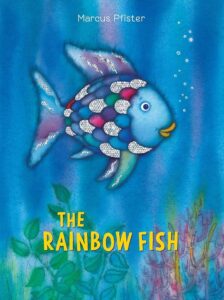
The Rainbow Fish — Marcus Pfister
What kids notice in this story:
Children often focus on the loneliness before the sharing.
They notice how being admired isn’t the same as being connected, and how isolation feels heavier than giving something away.
Story Snapshot:
A beautiful fish with shimmering scales learns that admiration doesn’t automatically lead to friendship.
Through reflection and guidance, he discovers a different way to relate to others.
Why this book helps kids who struggle with sharing:
The story frames sharing as a bridge to relationship, not an obligation.
Kids can see that generosity grows out of belonging, helping them understand that sharing doesn’t erase who they are—it deepens connection when they’re ready.
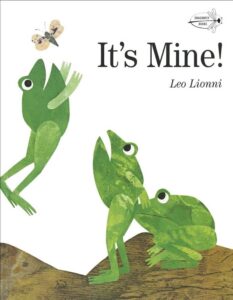
It’s Mine! — Leo Lionni
What kids notice in this story:
Kids notice the repetition of conflict and how exhausting it becomes. They also notice the relief when cooperation finally replaces competition.
Story Snapshot:
Three frogs argue constantly over territory and possessions until an unexpected event forces them to rethink how they live together.
Why this book helps kids who struggle with sharing:
This story shows how cooperation emerges from necessity and trust, not lectures. Kids can see that working together doesn’t mean losing individuality—it means feeling safer together.
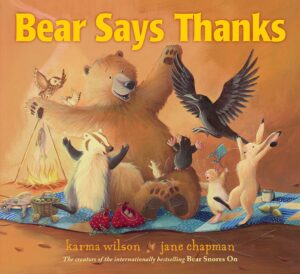
Bear Says Thanks — Karma Wilson
What kids notice in this story:
Children notice the warmth of reciprocity. They see characters offering help and kindness in different ways, not all of which involve giving up objects.
Story Snapshot:
Bear gathers ingredients for a feast with the help of his friends and later realizes how much everyone contributed.
Why this book helps kids who struggle with sharing:
The book broadens the idea of sharing beyond toys.
Kids learns to recognize that participation, presence, and effort all count, easing pressure around possession-based sharing.

What About Bear? — Suzanne Bloom
What kids notice in this story:
Kids notice imbalance. They sense when one character is overlooked and feel the quiet unfairness before it’s named.
Story Snapshot:
Bear patiently waits as others take turns playing, until the group realizes someone has been left out.
Why this book helps kids who struggle with sharing:
The story gently introduces fairness without blame.
Kids see how inclusion feels when it’s offered willingly, helping them understand turn-taking as relational rather than rule-based.

A Sick Day for Amos McGee — Philip C. Stead
What kids notice in this story:
Children notice the quiet care exchanged between characters. The sharing here is subtle—time, attention, companionship.
Story Snapshot:
Amos McGee regularly visits animals at the zoo, offering each exactly what they need. When Amos is sick, the animals return the kindness.
Why this book helps kids who struggle with sharing:
This story reframes sharing as mutual care. It helps kids see that generosity doesn’t have to be loud or immediate—it can be steady, reciprocal, and deeply safe.
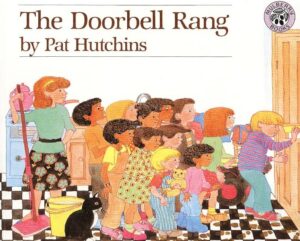
The Doorbell Rang — Pat Hutchins
What kids notice in this story:
Kids notice the changing portions and the rising concern. They feel the tension of scarcity and the relief of fairness unfolding.
Story Snapshot:
Two children plan to share cookies—until more friends arrive. Each ring of the doorbell changes the math.
Why this book helps kids who struggle with sharing:
The story makes fairness visible without judgment. Kids can explore how sharing adapts as situations change, supporting flexibility rather than rigid expectations.
If you’re looking to expand this emotional groundwork, you may also find comfort in books that focus on early friendships and social readiness, like those shared in this guide to making friends in early childhood, or in stories designed specifically for younger children navigating early sharing moments, such as these books for four-year-olds.
Sharing doesn’t arrive all at once. It grows quietly—through trust, repetition, and feeling safe enough to loosen your grip just a little.
Rereading these stories gives kids low-pressure practice. Each time, they notice something new.
Each time, the emotional muscles strengthen without anyone keeping score.
And if your child wants to go one step further, Scrively offers a space where kids can create their own stories about friendship, ownership, and cooperation—exploring sharing through characters that feel familiar, safe, and entirely their own.