
Books to Help 4-Year-Olds Learn to Share at School (Without Pressure)
You probably didn’t expect sharing to feel this complicated.
At four, your child is old enough to want friends, routines, and independence—and young enough to feel completely undone when someone else touches the block they were using.
Sharing isn’t just about generosity at this age. It’s about timing, control, identity, and learning where you end and someone else begins.
School makes all of this louder. Suddenly, there are shared bins, classroom rules, group activities, and peers who don’t instinctively know your child’s rhythms.
The expectations arrive all at once.
Wait your turn. Use your words. Share the crayons. Clean up together.
That’s a lot for a small nervous system to manage before lunchtime.
So when sharing falls apart—when grabbing happens, or tears show up, or your child insists something is “mine”—it isn’t a failure.
It’s information. It’s your child telling you they’re still learning how the social world works.
This is where stories help in a way lectures never can. Books let your child practice sharing from a safe distance.
They get to watch characters make mistakes, feel big emotions, repair relationships, and try again—without the pressure of getting it right themselves.
You don’t need a book that preaches. You need one that understands.
Why sharing feels especially hard at age four
At four, your child is balancing two powerful urges at the same time: the desire to connect and the need to stay in control. They want friends.
They also want certainty. Sharing threatens certainty.
In a classroom, sharing often comes with invisible rules—when to offer, how long to wait, what happens if someone doesn’t give it back.
Those rules aren’t obvious yet. Your child is still learning to read social cues, manage disappointment, and trust that their needs won’t disappear if they let go.
The right books meet your child exactly there. They don’t rush the lesson. They let the feelings come first.

Should I Share My Ice Cream? — Mo Willems
Core Themes:
- Decision-making
- Friendship
- Emotional honesty
Story Snapshot:
Gerald the elephant faces a dilemma: he has ice cream, and his best friend Piggie doesn’t. The story follows Gerald’s inner debate as he wrestles with wanting to enjoy something alone versus wanting to share it.
Why this book works well for learning to share at school:
This story slows the moment down. Your child gets to see how sharing isn’t automatic—even for adults.
It validates hesitation while gently showing how empathy changes the outcome. In a classroom context, it opens space to talk about thinking before reacting and noticing how others feel.
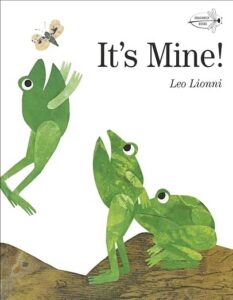
It’s Mine! — Leo Lionni
Core Themes:
- Ownership
- Conflict
- Cooperation
Story Snapshot:
Three frogs insist that everything belongs to them—until a shared problem forces them to rethink how they treat one another.
Why this book works well for learning to share at school:
This book mirrors what classroom conflict actually feels like. It doesn’t rush to kindness; it shows stubbornness first. Your child can recognize themselves in the frogs and see how cooperation emerges naturally when survival—and friendship—depend on it.

A Sick Day for Amos McGee — Philip C. Stead
Core Themes:
- Reciprocity
- Patience
- Gentle friendship
Story Snapshot:
Amos always makes time for his animal friends. When he gets sick, those same friends show up for him in thoughtful, unexpected ways.
Why this book works well for learning to share at school:
Sharing isn’t always about objects. Sometimes it’s about time and attention. This story helps your child see that relationships are built through mutual care—a powerful foundation for classroom cooperation.
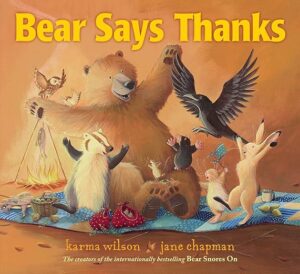
Bear Says Thanks — Karma Wilson
Core Themes:
- Gratitude
- Community
- Turn-taking
Story Snapshot:
Bear wants to host a feast but realizes he has very little to offer. His friends step in, each contributing something meaningful.
Why this book works well for learning to share at school:
The rhythm of this story mirrors classroom collaboration. Everyone brings what they can. Your child sees that sharing doesn’t require abundance—just willingness.
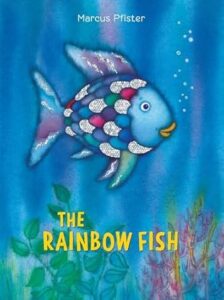
The Rainbow Fish — Marcus Pfister
Core Themes:
- Belonging
- Self-worth
- Generosity
Story Snapshot:
A beautiful fish learns that connection matters more than admiration when he’s faced with a choice about what to keep and what to share.
Why this book works well for learning to share at school:
This story opens conversation about balance—between keeping parts of yourself and offering others access. For school-age sharing, it helps children feel less afraid that giving means losing who they are.
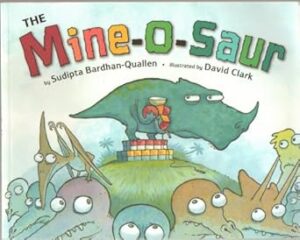
The Mine-O-Saur — Sudipta Bardhan-Quallen
Core Themes:
- Possessiveness
- Friendship repair
- Self-awareness
Story Snapshot:
A dinosaur loves his toys so much that he pushes everyone away—until he realizes what his “mine” mentality is costing him.
Why this book works well for learning to share at school:
This book uses humor to soften a hard truth. Your child can laugh while recognizing how exclusivity affects friendships, making it easier to talk about change without shame.

Have You Filled a Bucket Today? — Carol McCloud
Core Themes:
- Kindness
- Emotional awareness
- Positive social impact
Story Snapshot:
The story introduces the idea that everyone carries an invisible bucket that can be filled through kindness or emptied through unkind actions.
Why this book works well for learning to share at school:
For four-year-olds, this metaphor makes emotional cause-and-effect visible. Sharing becomes something that feels good rather than something required.

Waiting Is Not Easy! — Mo Willems
Core Themes:
- Patience
- Delayed gratification
- Trust
Story Snapshot:
Piggie asks Gerald to wait for a surprise. Gerald struggles mightily with the uncertainty, questioning whether waiting is worth it.
Why this book works well for learning to share at school:
Turn-taking requires waiting, and waiting feels endless at four. This story honors that discomfort while gently showing how patience supports shared joy.
How to Read These Books With Your 4-Year-Old
How you read these books matters just as much as which ones you choose.
At this age, sharing isn’t something your child needs explained in detail.
Instead, it’s something they need to experience—over and over, in low-pressure ways that feel safe.
That’s why it helps to slow the story down. As you read, pause occasionally and wonder out loud.
You might say, “Hmm, I wonder how that character feels right now,” or “What do you think might happen next?”
These gentle questions invite reflection without turning storytime into a lesson.
If your child wants to rush ahead, that’s okay too. For many four-year-olds, repetition does the real work.
Reading the same book again and again helps them absorb patterns—how conflicts start, how they change, and how repair happens. Over time, those patterns begin to show up in real life.
It also helps to connect stories to familiar school moments.
For example, you might mention circle time, shared toys, or lining up—without correcting or comparing.
The goal isn’t to point out mistakes. It’s to help your child recognize that the situations in books feel a lot like the ones they face every day.
Most importantly, model the language you hope they’ll use. When you narrate your own waiting, sharing, or turn-taking—“I’ll wait my turn,” or “We can use this together”—you give your child words they can borrow later. Stories plant the idea. Your calm presence helps it grow.
A gentle reminder as you keep going
Sharing doesn’t arrive fully formed. It grows slowly, through repetition, modeling, and trust.
Some days your child will surprise you. Other days they’ll cling tightly to what feels safe.
Both are part of learning. Books give you a steady, pressure-free way to return to the conversation again and again—without turning it into a power struggle.
If your child loves stories, you might also enjoy Scrively, where kids can create their own school-themed stories.
When children invent characters who navigate sharing, friendship, and classroom life, they practice those skills in a way that feels personal—and empowering.
Progress counts. Curiosity counts. And every shared page helps.