Help, My Child is a Volcano!” — Using Stories to Cool the Heat of Big Emotions
It starts as a low, almost imperceptible rumble, a tectonic shift in the atmosphere of your living room that you feel in your marrow before you hear it in the air.
One moment, the wooden blocks are a majestic castle; the next, they are jagged projectiles.
You see the sudden flush in their cheeks, the tightening of a tiny, resolute jaw, and the way their breath hitches in a chest that seems too small to contain the pressure building within.
Suddenly, the floor is lava and the air is thick with a frustration so immense it seems to swallow the very light in the room.
This is the volcano, and as a parent, you are often standing right at the edge of the crater, wondering how a person so small can generate a heat so fierce.
We have all been there, reaching for words that feel too flimsy to bridge the gap between their blinding rage and our desperate, flickering calm.
It is a lonely place to be, holding the weight of their big feelings while trying to steady your own internal compass.
You want to help them navigate the storm, but in the heat of the moment, the map is often blurred by tears—both theirs and yours.
We forget, in the middle of the noise, that self-regulation is not an innate switch that a child chooses to flip; it is a complex, delicate skill that must be built, piece by piece, like the very castles that were just scattered across your floor.
It is the slow work of learning how to recognize the smoke before the fire breaks out.
There is a unique kind of magic that happens when we step away from the aftermath of a meltdown and into the sanctuary of a story.
When the room is finally quiet and the adrenaline has ebbed away, opening a book becomes an act of restoration.
It provides a safe distance, a mirror that reflects their struggle without the sting of direct correction.
By watching a dragon fume or a mouse stomp, your child begins to see their own “volcano” from the outside. They find a vocabulary for the heat in their belly and the roar in their ears.
More importantly, they see that the eruption is not the end of the world—it is simply a moment that requires a different kind of strength to manage.
This collection of stories is designed to be your toolkit for those quiet intervals between the storms.
These are not just narratives; they are blueprints for emotional architecture. They offer rhythmic reminders that feelings are like weather—powerful, inevitable, but ultimately passing.
Through these pages, you can show your child that while we cannot always control when the volcano blows, we can absolutely learn how to tend to the landscape once the lava cools, and eventually, how to recognize the tremors before they become an earthquake.
Books to Help Your Little One Manage the Heat of Big Emotions
Fergal is Fuming! by Robert Starling
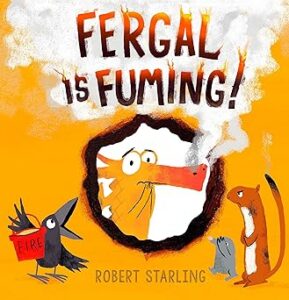
There is something inherently relatable about a dragon who cannot quite keep his fire under control, and Fergal is the patron saint of every child who has ever felt their temper get the better of them.
The book carries a whimsical, vibrant energy that captures the chaotic heat of a tantrum without making the protagonist feel like a villain.
It creates a space where anger is seen as a natural physical reaction—a burst of flame—rather than a moral failing, which is a distinction every parent needs to make.
What kids notice: The way the fire literally shoots out of Fergal’s mouth when things don’t go his way, and how his dragon-sized outbursts actually end up ruining the very things he wanted to enjoy, like his dinner or a game with friends.
Story snapshot: Fergal is a nice dragon, but when he’s told “no” or things get frustrating, he loses his cool—literally.
He burns his dinner, he burns the football goal, and he even burns his friends’ toys. It isn’t until his mom shows him that even dragons have ways to cool down that Fergal learns to stop the fire before it starts.
Why this book helps: Self-regulation often begins with a visual understanding of consequences, and Fergal provides that in spades.
By showing the scorched earth left behind by a tantrum, the story helps children realize that anger often hurts the person feeling it just as much as those around them.
It introduces the concept of “cooling down” as a physical necessity, turning the abstract idea of emotional control into something as tangible as a dragon putting out his own fire.
This book helps by validating the intensity of the feeling while gently pointing toward the restorative power of a deep breath and a moment of pause.
Ravi’s Roar by Tom Percival
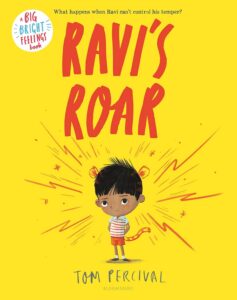
Being the smallest in the family comes with a unique set of frustrations, and Ravi’s journey from a quiet boy to a roaring tiger is a masterpiece of emotional storytelling.
The prose is rhythmic and empathetic, speaking directly to the sense of unfairness that often triggers a child’s biggest meltdowns.
It captures the intoxicating power of letting go of your temper, but it doesn’t stop there; it lingers on the isolation that follows when the roar has pushed everyone else away.
What kids notice: Ravi’s physical transformation into a bright orange tiger, complete with claws and a tail, which perfectly visualizes how it feels when anger makes you feel like a completely different, much wilder creature.
Story snapshot: Ravi is the smallest in his family, and one day, after being left out and coming last yet again, he has had enough.
He grows a tail, he grows fur, and he roars his way into getting exactly what he wants. But he soon finds that being a tiger is lonely because no one wants to play with someone who only knows how to roar.
Why this book helps: This story is a profound lesson in the social cost of poor self-regulation.
While it acknowledges that “roaring” can feel good in the moment, it highlights the loneliness that follows when we use our anger to dominate others.
It helps children understand that while their feelings are valid, the way they express them affects their relationships.
By the end, Ravi learns that being human—and being kind—is much more rewarding than being the loudest animal in the room. It encourages kids to find their voice without losing their heart in the process.
Mouse Was Mad by Linda Urban
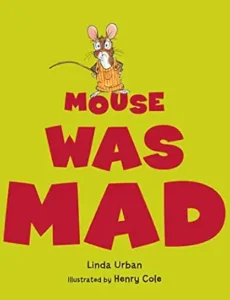
Sometimes the best way to teach a complex virtue is through a series of failed experiments, and Mouse is the perfect scientist of rage.
This book is delightful because it explores the different “styles” of anger that other animals have, from hopping to screaming to burrowing.
It is a quiet, rhythmic book that mimics the process of finding one’s own center, making it an excellent choice for children who feel overwhelmed by the noise of their own emotions.
What kids notice: The funny ways the other animals show their anger and how Mouse tries to copy them, only to realize that he isn’t very good at hopping or stomping like the others do.
Story snapshot: Mouse is hopping mad, but when he sees a rabbit hopping, he realizes his own hops aren’t quite right.
He tries to scream like a bobcat and stomp like a bear, but each time, he finds he’s just not doing it “right.” Finally, he discovers his own way to be mad: standing perfectly still and breathing until the madness goes away.
Why this book helps: It shifts the focus from the explosion to the “how-to” of calming down.
By showing Mouse rejecting the loud, externalized anger of others in favor of a quiet, internal stillness, the book offers a sophisticated model of self-regulation.
It teaches children that they have a choice in how they express their frustration.
The act of “standing still and being quiet” is presented not as a punishment, but as a specialized skill that Mouse masters. It empowers children to find their own “quiet place” within themselves when the world feels like it’s spinning out of control.
Anh’s Anger by Gail Silver
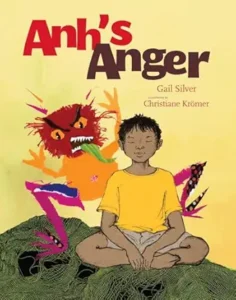
This book takes a slightly more mindful, almost meditative approach to the volcano. It personifies anger as a guest that comes to visit, which is a powerful psychological tool for children.
Instead of fighting the feeling or being ashamed of it, the protagonist is encouraged to sit with it.
The language is soft and intentional, guiding the reader through the physical sensations of anger without any judgment, making it a cornerstone for emotional intelligence.
What kids notice: The character of Anger itself—a large, hairy, reddish creature that doesn’t look scary, but rather looks like it just needs a place to sit down for a while.
Story snapshot: After being sent to his room for an outburst, Anh is visited by his anger. Instead of yelling back, Anh sits on the floor with the creature. They breathe together, they dance together, and eventually, the anger begins to shrink until it is small enough to fit in Anh’s hand and disappear.
Why this book helps: This is a masterclass in the virtue of self-regulation because it teaches the “allowance” of emotion.
Often, we tell kids “don’t be mad,” which only adds shame to the fire. This book says, “You are mad, let’s look at that.”
By sitting with the anger and breathing, Anh learns that he is separate from his feelings. He is the host, and the anger is just a guest.
This separation is the key to self-regulation; if a child realizes they are not their anger, they realize they have the power to let that anger go when it’s time for the guest to leave.
When Sophie Gets Angry—Really, Really Angry… by Molly Bang
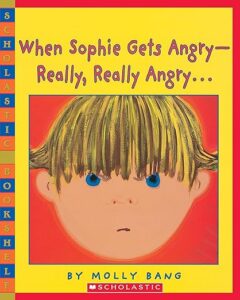
Molly Bang’s use of color in this classic is legendary for a reason.
The illustrations pulse with a vibrant, vibrating red when Sophie is at her peak, and slowly transition into cool blues and greens as she finds her way back to herself.
It’s a book that respects the sheer scale of a child’s fury, acknowledging that sometimes, the only way through it is to remove yourself from the situation entirely and find solace in the world outside.
What kids notice: The way the world looks different when Sophie is mad—the sharp lines and the “roaring” red—and how much calmer and wider the world feels when she climbs her favorite tree by the ocean.
Story snapshot: When Sophie’s sister grabs her toy, Sophie becomes a “simmering volcano.”
She runs out into the woods, she cries, and she looks at the water. The wide world and the steady breeze help her feel better, and when she returns home, everything is just as she left it, but she is ready to be part of the family again.
Why this book helps: It models the healthy coping mechanism of “taking a break.”
Sophie doesn’t wait for someone to tell her to go to her room; she instinctively seeks out nature to regulate her nervous system.
This helps children understand that they can seek out calming environments when they feel a “burn” coming on. It validates the need for space and movement in the process of calming down, showing that self-regulation isn’t just about sitting still—it’s about finding what your body needs to feel safe again.
My Mouth Is a Volcano! by Julia Cook
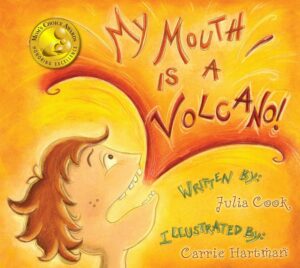
While often used to talk about interrupting, this book is fundamentally about the impulse control side of self-regulation.
It uses the metaphor of a volcano in a very literal way, describing the physical sensation of words “sliding” up the throat and “erupting” out of the mouth.
It is funny, slightly exaggerated, and incredibly effective at giving kids a concrete way to think about their verbal outbursts.
What kids notice: The way Louis’s tongue itches and his teeth jiggle right before he “erupts,” and how it feels when other people’s volcanoes erupt all over his own stories.
Story snapshot: Louis has a lot to say, and he thinks everything he has to say is very important.
His words start to wiggle and jiggle until they just burst out, interrupting everyone.
It’s only when he gets interrupted himself that he realizes how it feels to be on the receiving end of a volcano, and he learns a trick to “catch” his words and wait his turn.
Why this book helps: It focuses on the “pre-eruption” phase. Self-regulation is most effective when a child can catch the feeling before it becomes an action.
By identifying the physical “jiggles” and “wiggles” of an impulse, Louis gives children a vocabulary for their own internal physical cues.
The book teaches a specific technique for holding onto a thought without losing it, which reduces the anxiety that often leads to shouting or interrupting. It’s a practical, actionable guide disguised as a silly story.
Little Monkey Calms Down by Michael Dahl
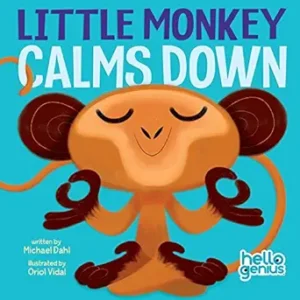
For our youngest readers, the path to self-regulation needs to be simple, rhythmic, and incredibly gentle.
This board book is a soothing balm for the toddler years, where the volcano blows over things as small as a dropped ice cream cone.
It doesn’t use many words, but the ones it chooses are perfect for creating a predictable, calming routine that parents and children can mirror in real life.
What kids notice: Little Monkey’s very sad face when his ice cream falls and the way he uses his favorite blanket and a quiet space to help himself feel better.
Story snapshot: Little Monkey is having a very hard time. He’s crying, he’s kicking, and he’s feeling very small. But then, he takes a deep breath. He cuddles his blankie. He stays quiet. Slowly but surely, Little Monkey calms down and is ready to go back out and play.
Why this book helps: It provides a “script” for calming down that is accessible to toddlers.
Self-regulation at this age is about sensory management—blankets, quiet, and breathing. By repeating the simple steps Little Monkey takes, parents can create a ritual that the child recognizes.
The book reinforces the idea that even though you are sad or mad right now, you won’t feel this way forever.
It’s a foundational lesson in emotional endurance: the feeling has a beginning, a middle, and—with a little help—an end.
Allie All Along by Sarah Lynne Reul
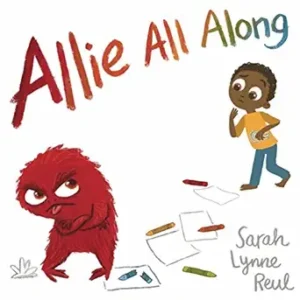
This is a clever and visually stunning exploration of the “layers” of anger.
Allie starts as a jagged, bright red shape, and as her brother helps her navigate her frustration, her colors and shapes change.
It is a brilliant way to show that anger is often a mask for other things—tiredness, hunger, or just a really bad day—and that beneath the “monster” is still the child you love.
What kids notice: How Allie’s color changes from a furious, spiky red to a grumpy orange, then a yellow, and finally back to her normal self as she calms down bit by bit.
Story snapshot: Allie is having a colossal tantrum. Her brother doesn’t get mad back; instead, he tries different things to help her.
He gives her a snack, he gives her a toy, and he gives her space. With each step, the “angry Allie” sheds a layer, revealing the real Allie underneath who just needed a little help finding her way back.
Why this book helps: It teaches children (and reminds parents!) that calming down is a process, not an event.
You don’t just go from “volcano” to “calm” in one second; you move through shades of frustration. It also highlights the role of co-regulation—how a calm older sibling or parent can help “peel back” the layers of rage.
For a child, seeing the visual representation of their anger diminishing layer by layer makes the process of self-regulation feel achievable rather than impossible. It turns the “volcano” into a series of small, manageable steps.
Crabby Pants by Julie Gassman
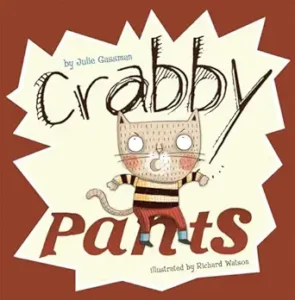
Sometimes, we just need to laugh at the absurdity of our own bad moods, and *Crabby Pants* does this with a wink and a nod. It’s a story about a character who knows he’s being “crabby” but can’t quite seem to stop himself.
It’s a great way to introduce the idea of self-awareness as the first step in self-regulation—recognizing that you are, in fact, wearing your “crabby pants” today.
What kids notice: The funny “crabby” things the main character does, like scowling at the sun for being too bright or the birds for being too loud, and how he eventually decides he’s done being a crab.
Story snapshot: Roger is a crab. Or rather, he’s a boy who is acting like a crab. He’s in a bad mood, and he wants everyone to know it. He finds reasons to be upset about everything.
But eventually, Roger realizes that being a crab isn’t actually that much fun, and he has to figure out how to take those crabby pants off and put on some happy ones instead.
Why this book helps: It uses humor to disarm the tension of a bad mood. Humor is a powerful tool for self-regulation because it requires a shift in perspective.
By laughing at Roger, a child can begin to see the humor in their own minor frustrations. It encourages a lighthearted self-reflection: “Am I being a bit of a crabby pants right now?”
This question alone is an act of regulation, as it forces the child to step outside their feeling and evaluate it. It’s a gentle, funny way to build the “internal observer” that we all need to keep our volcanoes in check.
Put Your Child in the Heart of the Story
While these books offer incredible mirrors for your child’s emotions, imagine the power of a story where your child is the one learning to breathe through the fire.
At Scrively, we believe that the most effective way to teach virtues like self-regulation is to make the lesson personal.
Our custom-tailored books allow you to place your child directly into the narrative, facing their own “volcano” moments and discovering their unique “calm-down” superpowers.
When a child sees their own name on the page, the bridge between the story and their real life becomes shorter and stronger.
You aren’t just reading about a dragon; you are reading about your own brave little hero navigating the big, beautiful world of feelings.
The volcano will blow again; that is the nature of growing up.
There will be more blocks thrown, more “not fairs” shouted, and more moments where the air feels heavy with heat.
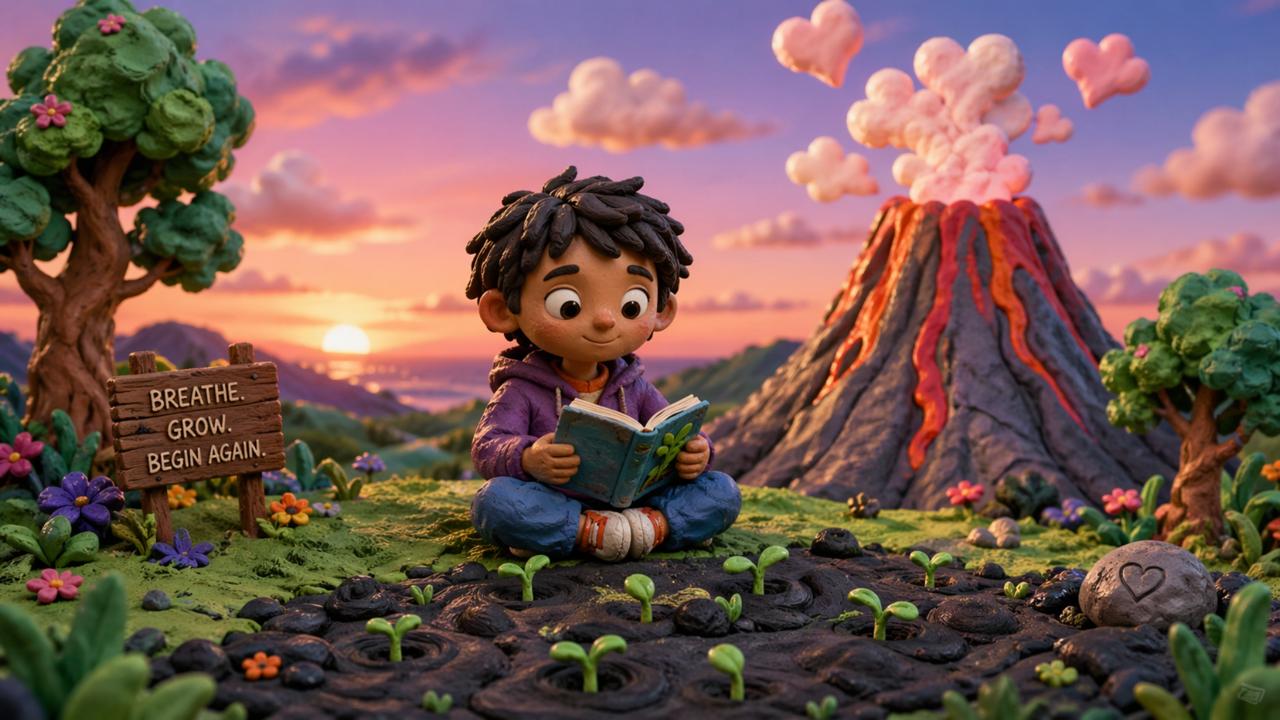
But every time you open one of these books, you are handing your child a small, sturdy shovel. You are teaching them how to clear the path, how to plant new seeds in the cooled ash, and how to stand tall even when the ground beneath them shakes.
Self-regulation isn’t about never being angry; it’s about knowing that you have the tools to return to the quiet, the calm, and the connection that waits on the other side of the smoke.
Keep reading, keep breathing, and remember: you are the steady ground they need to find their balance.